Michigan cottage food law: the new $50,000 cap, what you can sell, labels, and markets
Michigan's cottage food law now allows $50,000 a year in sales and shipping within the state. What you can make, the label line, and what Michigan markets ask for.

Agustin Garcinuño15 min read
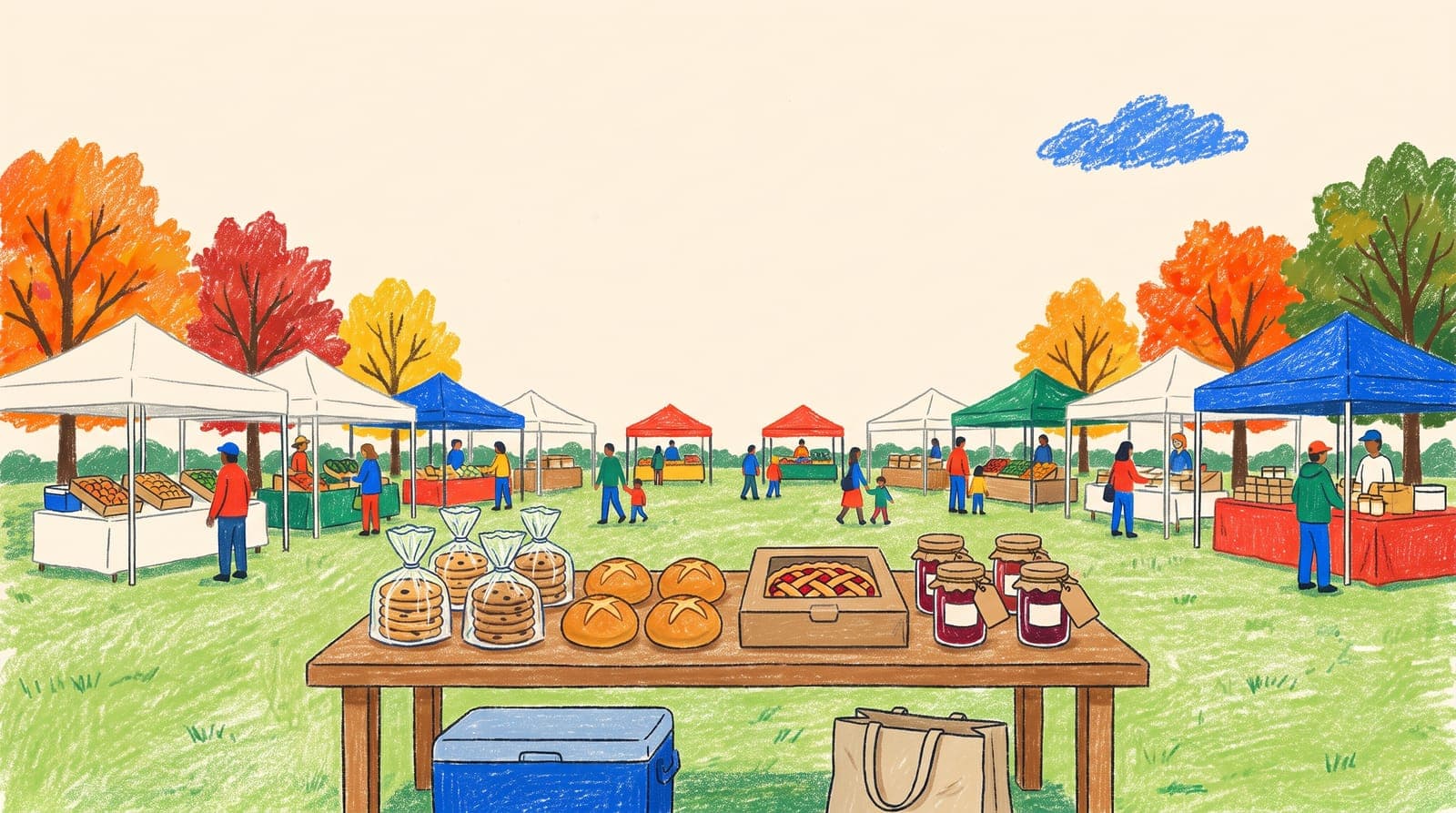
Michigan has let people sell bread, cookies and jam from their home kitchens since 2010, with no license and no inspection. For most of that time the law had two limits that shaped every home baker's season: you had to hand the food to the customer yourself, and you had to stop at $25,000 a year.
Both changed on March 24, 2026. A new law doubled the cap, opened up online orders and shipping within the state, and added an optional registration number that keeps your home address off your labels. A lot of what's online still describes the old rules. This guide covers the law as it stands in October 2026: what you can make, how much you can sell, what goes on the label, and what Michigan farmers markets and holiday markets ask cottage food vendors for, counted from our catalog. For how Michigan compares with other states, see our state-by-state cottage food license guide.
The short answer
- No license, no inspection, no fee. Under MCL 289.4102, a cottage food operation is exempt from Michigan's food licensing and inspection rules. The Michigan Department of Agriculture and Rural Development (MDARD) says there are "no application forms to complete."
- The cap is $50,000 a year, or $75,000 if your products sell for $250 or more each, since Public Act 51 of 2025 took effect on March 24, 2026. It was $25,000.
- Only foods that keep at room temperature. Breads, cookies, cakes, candy, fruit jams, granola, dry mixes. No cream cheese frosting, no cheesecake, no salsa, no jerky, no drinks, per MDARD's food list.
- Sell in person, online or by mail, inside Michigan only, as long as the buyer can talk to you before the sale. Never wholesale, to stores or on consignment.
- Markets add their own rules. On October 6, 2026, 25 of the 103 Michigan farmers markets in our catalog said something about cottage food in their vendor rules. Two don't accept it at all, and four ask about food safety training the state doesn't require.
What changed in 2026: the cap, shipping and a registration number
House Bill 4122 passed the Senate 35 to 0 in December 2025, was signed on December 23, 2025, and became Public Act 51 of 2025. The amended law took effect on March 24, 2026. MDARD's summary of the update lists two headline changes, and the statute adds a third:
- A higher cap. Gross sales can reach $50,000 a year, or $75,000 "if the products sold cost $250 or more per unit." MDARD's own announcement put the old cap at $25,000.
- Online, mail and delivery-app sales. You can now sell by internet or mail order, or deliver through a third-party platform, "if the cottage food operation provides an opportunity for a consumer to directly interact with the cottage food operation before the cottage food product is sold" (MCL 289.4102(4)). All of it stays inside Michigan.
- An optional registration number. If you register with the MSU Product Center, you can print a registration number and phone number on your labels instead of your home address (more below).
A Michigan home baker summed up the first change in a video (March 2026): "The old rule, we were capped at $25,000 in gross sales per year. The new cap has been raised to $50,000."
The cap can also rise on its own now. Starting October 1, 2026, and each October 1 after that, the statute lets MDARD raise both limits for inflation, using the Detroit consumer price index, and the adjustment can't lower them. On October 6, 2026, MDARD's selling page still listed $50,000 and $75,000, so check it each fall.
If a guide, a market packet or even a university page tells you the limit is $25,000 or that you can't ship, it's out of date. The MSU Extension cottage food page still said the cap was $25,000 and that nothing can be sold "online (including Facebook) or via mail" when we checked on October 6, 2026.
Do you need a license or registration in Michigan?
No license and no required registration. MDARD's FAQ says it plainly: "There are no application forms to complete, no registration process, and you do not need to obtain a food license or permit from MDARD."
The exemption covers state food licensing and routine inspection only. MDARD still investigates complaints, and during one it can enter your kitchen, copy records, seize product, and order you to stop making foods that aren't allowed. Local rules still apply too: MDARD tells home bakers to check zoning with their city or township, and a county may want a DBA if you use a business name.
The $50 registration is optional. The 2026 law lets the MSU Product Center register cottage food businesses. It costs $50 once, and the number it issues can replace your home address on your labels. MSU Extension pitches it as a way to keep your address private and to "demonstrate legitimacy when selling at farmers markets, events or directly to consumers." A Michigan baker explained the appeal on video: "Instead of putting our home address on every single label, we can use a registration number which is provided by the state." (It's issued by MSU's Product Center under the state law.)
Training is optional at the state level, but not always at the market. MDARD points to an MSU Extension online course that covers safe production, packaging, labeling and storage. The law doesn't require it. Some markets do (see below).
What Michigan lets you make, and the buttercream rule
The 2026 law defines a cottage food product as any food that isn't "time/temperature control for safety," meaning it can sit at room temperature without becoming unsafe (MCL 289.1105). It names "jams, jellies, dried fruit, candy, cereal, granola, dry mixes, vinegar, dried herbs, and baked goods" as examples, and rules out salsa, canned low-acid foods, meat and poultry, milk products, bottled water and other beverages, and ice.
MDARD's food list settles the edge cases:
| Category | Allowed | Not allowed |
|---|---|---|
| Baked goods | Breads, cookies, muffins, shelf-stable and cooked fruit pies, celebration cakes and cupcakes, breads with shredded hard cheese baked in | Cream, custard, pumpkin and lemon meringue pies, cheesecake, cakes with frosting that needs refrigeration |
| Candy | Candies made without alcohol, cotton candy, chocolate-covered pretzels and strawberries, nuts, maple candy, freeze-dried candy, flavored honey | Caramel apples, truffles or chocolates with alcohol, simple syrups, elderberry syrup |
| Jams | Fruit jams and jellies in glass jars | Hot pepper jelly and other vegetable jams, low-sugar or no-sugar jams, apple butter and other fruit butters |
| Dry goods | Granola, dry baking, dip and soup mixes, dried herbs, dehydrated fruit, dried pasta, popcorn, roasted coffee | Sourdough starter, kombucha and other fermented foods |
| Drinks | Powdered drink mixes, dry tea mixes | Juice, cider, lemonade, kombucha, any ready-to-drink beverage |
| Other | Nut butters, vinegars, oils flavored with dried herbs (no garlic) | Sauces, salsa, hummus, jerky, cheese, yogurt, fresh pasta, anything with CBD |
Frosting is the rule people miss. Icings made only with shelf-stable ingredients are fine. Buttercream is allowed only if you follow one of two lab-tested recipes MDARD approves, from Kansas State University and Texas Come and Bake It, "followed exactly with no changes in proportions of ingredients, no subtractions, and no additions" other than coloring or flavoring. Cream cheese frosting is out. A Michigan baker said on video (February 2026): "We are not allowed to use cream cheese in anything, unfortunately, under the cottage food law. Really, anything that has to be refrigerated, we can't use." Another Michigan bakery posted a tutorial for the approved buttercream and said: "I strictly follow the Michigan Cottage Food Law provided recipe."
When a food isn't on the list, ask MDARD before you sell it. A Michigan baker on r/Baking asked about ermine frosting, a cooked milk frosting, and the top answer was to call the department: "You can call them and get guidance." MDARD takes cottage food questions at MDARD-CottageFood@michigan.gov.
The food also has to be made at home and sold as made at home. A Michigan cotton candy business that got a license explained on video (June 2026) why: "legally I can spin for people in front of people, 'cause you can't do that with cottage food law." Cooking or spinning at the event is a licensed food operation.
Online orders, shipping and pickup: the "directly interact" rule
The 2026 change is what lets a market baker take preorders and ship a holiday cookie box across the state. The conditions, from MCL 289.4102(4) and MDARD's selling page:
- The buyer must be able to talk to you first. "Directly interact with" means "either a face-to-face meeting or a virtual meeting," and a virtual meeting is two-way electronic communication where the parties "can see or be seen and hear or be heard." MDARD's summary puts it as the consumer having "an opportunity to speak to the cottage food operator."
- Michigan buyers only. Online, mail and delivery-app sales "must be sold or delivered only to a consumer in this state." MDARD says to check with the other state before selling there.
- Payment can be digital. MDARD says you "may advertise online and collect payments in-person or through a pay app."
- No go-betweens. A farm stop or market can't hold your preorders for customers to pick up. MDARD answered that question directly: the law doesn't let a retail market "serve as go-between or provide temporary storage."
What hasn't changed: no wholesale, no sales to restaurants or grocery stores, no consignment, and no donating your product to a raffle or fundraiser auction, though you can give it away yourself from your booth. A Michigan baker said on video: "The law still says we can't sell wholesale… it still must be direct to consumer."
Michigan cottage food labels, with or without your address
Every product must be "prepackaged and properly labeled before sale" (MCL 289.4102). The label needs:
- Your business name and home address, or, if you registered with the MSU Product Center, your business name, phone number and registration number. MDARD's labeling page says the address must be the physical address of your home kitchen; "Post Office Box addresses are not allowed."
- The product name.
- The ingredients in descending order by weight, including sub-ingredients of anything prepared ("soy sauce (wheat, soybeans, salt)", not "soy sauce").
- The net weight or volume, which MDARD says "must also include the metric equivalent," as in its sample label: "Net Wt. 3 oz (85.05 g)."
- Allergens, as federal labeling rules require. MDARD's page lists eight groups. Federal law made sesame the ninth major allergen on January 1, 2023, so list it too. Name the specific tree nut ("almonds," not "nuts").
- Nutrition facts, only if you make a nutrition claim.
- This statement, in at least 11-point type (about 1/8 inch) in a contrasting color: "Made in a home kitchen that has not been inspected by the Michigan department of agriculture and rural development."
Hand-printed labels are fine if they're legible, in permanent ink and big enough. For wedding and birthday cakes you can't stick a label on, the label information goes on the invoice delivered with the cake; smaller cakes go in a labeled box. Labels are also what markets check: Bellevue's application asks "Do your product labels meet Michigan Cottage Food requirements?" (listing), and Chelsea asks for "product label samples" (listing).
Your kitchen, your storage and the per-person cap
- Your primary home only. The kitchen has to be in the house, apartment or rental you live in, in Michigan. MDARD's FAQ rules out second homes, cottages, motor homes and outbuildings, and a rented commercial kitchen. Once you rent a licensed kitchen, you need a food establishment license.
- Storage in the house too. Ingredients and finished products go in "your kitchen, a spare room or a basement" that's dry and pest-free, not a garage, shed or barn, per MDARD's selling page.
- Well and septic. If you're on a well, MDARD says to test the water at least once a year. It also warns that a home bakery "can put your septic system at risk of early failure" and suggests an evaluation from your local health department first.
- The cap counts per person. The statute computes gross sales "on a per-person basis within or at a particular domestic residence." MDARD's FAQ gives the example of a mother and child in the same house who each run a cottage food business: each can sell up to the limit. Family members who don't run one don't add to it.
- Keep records. MDARD can ask, in writing, for records that verify your annual gross sales. Card reader reports and a cash log for each market day cover it.
Sales tax on cottage food in Michigan
The cottage food exemption isn't a tax exemption. Asked whether cottage food businesses need to collect and report sales tax, MDARD answers "Possibly," and it sends you to the Department of Treasury, adding that "in general, sales tax is not charged on prepackaged foods that are not for immediate consumption."
Treasury's notice on prepared food explains why. Michigan's constitution bars sales tax on food except "prepared food," and prepared food includes food sold heated, ingredients combined by the seller and sold as one item, and food sold with eating utensils the seller provides. But "bakery items, including bread, rolls, buns, biscuits, bagels, croissants, pastries, doughnuts, danish, cakes, tortes, pies, tarts, muffins, bars, cookies, and tortillas, sold without eating utensils" are excluded from prepared food. A wrapped loaf or a bag of cookies handed over without a fork or napkin is generally untaxed food. Hand out forks and plates for a slice of pie at your booth and that changes. For anything that isn't a bakery item, or if you're unsure, ask Treasury.
Markets ask anyway. Canton Farmers Market asks every applicant for a "Sales Tax I.D.," the Oakland County Farmers Market asks for a sales tax license number, and Riverside's Holiday Art Fair in Ypsilanti says "Vendors manage their own payment systems and collect their own sales tax."
What Michigan markets ask cottage food vendors for
MDARD says plainly that a market can ask for more than the law does: "some farmers markets or other direct marketing venues may require vendors to have a food establishment license or to meet other requirements." On October 6, 2026, 25 of the 103 Michigan farmers markets in the Vendorbound catalog said something about cottage food in their vendor rules. Only 2 of the 100 Michigan holiday markets did, so ask a holiday organizer directly. Here's what the farmers markets ask:
Two don't accept cottage food.
- Holland Farmers Market: "Goods produced at home under Cottage Law are not accepted; all goods must be produced in a licensed kitchen."
- Fulton Street Market in Grand Rapids requires an MDARD or health department license and "documented commercial kitchen use" ("no cottage food").
Four ask about food safety training.
- Walled Lake Market Place: "Cottage Food vendors must provide proof of food safety training: ServSafe certification or the MSUE online video."
- Richmond Artisan & Farmers Market: "Cottage Food Law Certification (MSU Extension) - a copy must be provided before selling homemade food items at the market."
- Oakland County Farmers Market in Waterford: "Have you taken the Cottage Food Law Course? Yes / No."
- Hastings Farmers Market asks cottage food producers whether they're "current on Food Safety Rules and Standards," on labeling, and on "acceptable foods and storage requirements."
Others ask you to show you qualify. Chelsea wants a food establishment license "or representation of Cottage Food Law qualification, plus copies of any inspections and product label samples." The Pittsfield Township market in Ann Arbor asks for "Cottage Food Law compliance for cottage food vendors" with your application. At the South Lansing Farmers Market, cottage foods are exempt from the license it requires of other food vendors, but pet foods and "refrigerated or pickled items" aren't.
Insurance is a market rule, not a state one. The Dexter Farmers Market says liability insurance is "encouraged (not required)" for cottage food vendors. Our vendor insurance guide covers what a policy costs.
So the state asks for nothing, but a market application often asks for a training record, a label sample or proof that you qualify. Have those ready before you apply. For the rest of an application, from booth fees to what to bring, see how to sell at a farmers market.
When you need a license instead
You're outside the cottage food law if your food needs refrigeration (cheesecake, cream cheese frosting, meat pies), if you want to sell to stores or restaurants, ship out of state, make food at the event, bake in a rented commercial kitchen, or pass the cap. MDARD says then you need a food establishment license. A commenter on r/AnnArbor put it simply to a would-be market vendor: "If what you're making doesn't fall into the permitted list, you'll need a commercial kitchen."
Where to sell cottage food in Michigan now
Live from the Vendorbound catalog
3,881 farmers markets and holiday markets are taking vendor applications now
5,837 in the catalog. Where there are the most:
- Farmers markets in California371 open
- Farmers markets in Florida186 open
- Farmers markets in Texas159 open
- Holiday markets in Texas117 open
- Holiday markets in Ohio94 open
- Holiday markets in Florida94 open
Outdoor markets are winding down for the year, but winter markets and holiday markets run through December. The Dexter Winter Farmers Market, for one, runs from November 7, 2026 to April 17, 2027 and lists cottage food as exempt from its health inspection rule. What a market day pays varies. A Michigan bakery said on video after a September 2026 market: "I only came home with two loaves of bread, which is phenomenal," and a week later reported "$162.13. Didn't really reach my goal, but you know what, it's okay. You're going to have on and off days." Browse Michigan farmers markets and Michigan holiday markets and check each market's food rules before you apply.
Frequently asked questions
Do I need a license to sell baked goods from home in Michigan?
No. Michigan doesn't issue a cottage food license or require registration. You can sell allowed foods made in your home kitchen as long as you stay under the sales cap and label every item. An optional $50 registration with the MSU Product Center lets you put a registration number on your labels instead of your address.
What is the cottage food sales limit in Michigan in 2026?
$50,000 a year in gross sales, or $75,000 if your products sell for $250 or more per unit, since March 24, 2026. It was $25,000 before. From October 1, 2026, MDARD may raise the limits each year for inflation.
Can I ship cottage food in Michigan?
Yes, since March 24, 2026, but only to customers in Michigan, and only if the customer has a chance to interact with you, face to face or in a virtual meeting, before buying. You can also deliver through a delivery app on the same terms.
Can I sell buttercream or cream cheese frosting under Michigan's cottage food law?
Cream cheese frosting, no. Buttercream only if you follow one of MDARD's two approved lab-tested recipes exactly, or use a commercially made shelf-stable frosting.
Can a Michigan farmers market require a license from a cottage food vendor?
Yes. MDARD says markets can require a food establishment license or other things. Some Michigan markets don't accept cottage food, and several ask for food safety training or label samples.
Do I charge sales tax on cottage food in Michigan?
Usually not on bakery items sold without eating utensils, which Michigan treats as untaxed food. Food sold hot or with forks, plates or napkins you provide can be taxable. Check with the Michigan Department of Treasury for your products.