How to start an embroidery business: machine costs, what sells at markets, and pricing
How to start an embroidery business that sells at craft fairs: machines from $780, the $1 per 1,000 stitches rule, $5 names at the booth, and the label rules.

Agustin Garcinuño16 min read
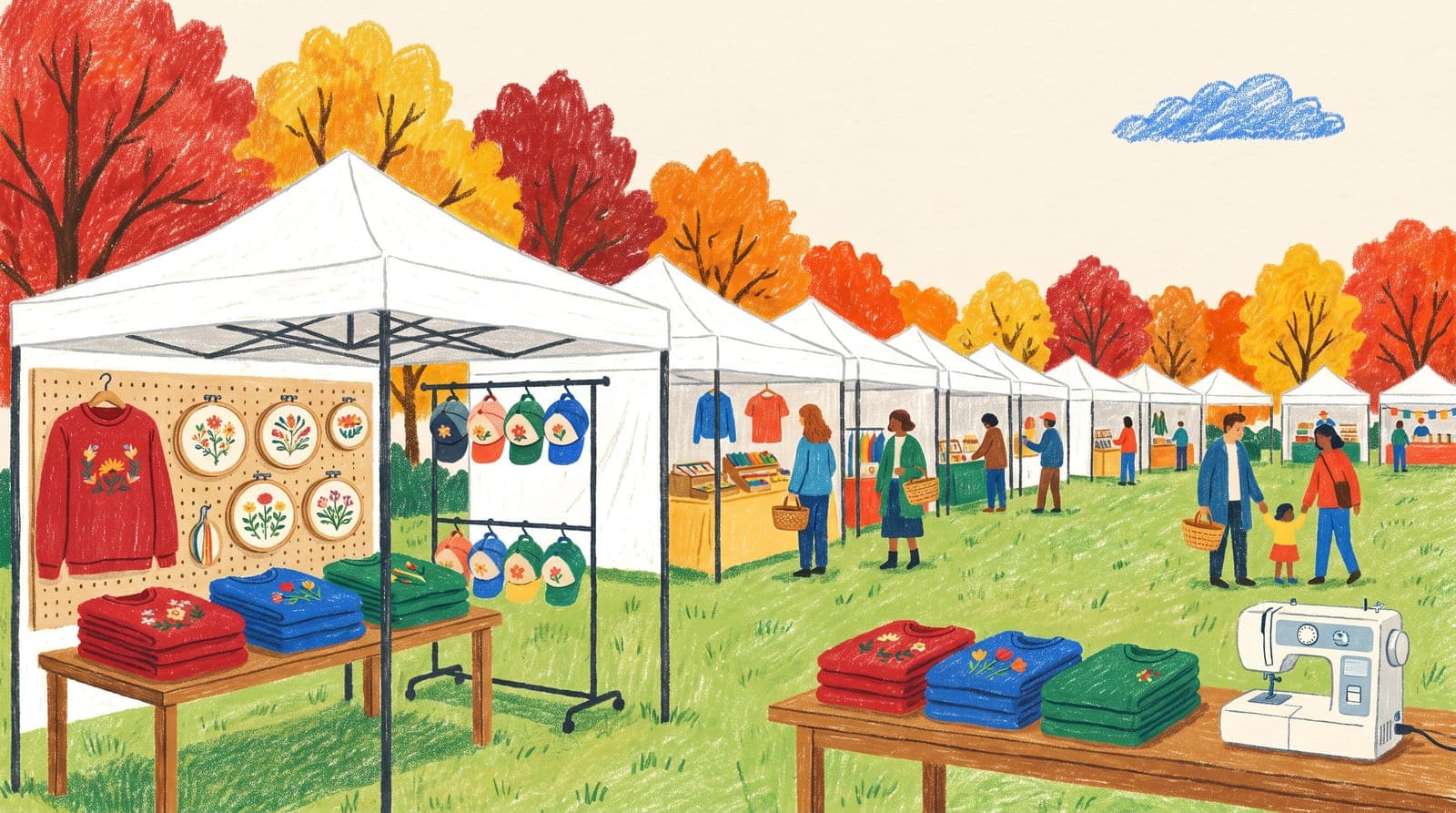
Embroidery has an advantage most crafts don't: it can put a shopper's name on something while they wait. A sweatshirt, a dog bandana or a tote becomes a gift with one person's name on it, and that is hard to find at the big-box store. The catch is the machine. A home embroidery machine stitches one color at a time, a commercial one costs as much as a used car, and hand embroidery takes hours a piece.
This guide is for people deciding whether to turn embroidery into a market table, by hand or by machine. It covers what sells at craft fairs and holiday markets, what the equipment costs, how embroiderers price their work, what it takes to personalize at the booth, the label and design rules, and how to get into shows that already have plenty of fiber vendors.
The short answer
- Personalization is what sells at a booth. Embroiderers who stitch on site sell names on sleeves for $5, pet bandanas for $10 to $15, and totes for $40, with each item ready in minutes.
- The machine is the business. A single-needle home machine like the Brother PE800 lists at $779.99. A 15-needle commercial machine runs about $6,400. Hand embroidery costs little to start, but the hours price most pieces out of a market table.
- Price by stitch count, plus the blank. A common retail starting point among machine embroiderers is "$1 per 1000 stitches with a minimum charge."
- Labels: clothing and towels need a federal fiber content label. Hats and tote bags don't. Embroidery that covers 15% or less of the item can be left off the fiber count with "exclusive of decoration."
- Don't stitch logos you don't own. Team, brand and character marks belong to their owners. Bought design files come with license terms; read them.
- Power isn't a given. Of 37 listings in our catalog that name embroidery as a vendor category, 21 say something about electricity, from a $20 add-on to "no electricity for outdoor booths."
What embroidered items sell at craft fairs and markets
Ask embroiderers what sold and the answers change with the crowd. One farmers market seller put it in a caption: "It always surprises me what our best sellers are each week! & that it's always different!" Their top three that week, from a video in June 2026: "Fish tanks!", "Bee tanks!" and "Catch ya later tees!" Still, a few patterns repeat.
Names and initials. @wishesthreadco, a vendor who embroiders on the spot at fall festivals and markets, wrote in an August 2026 caption that names on sleeves are "probably our best seller (other than pet collars), especially on the mama & nana items we bring!" On Reddit, a machine embroiderer setting up for a preschool vendor event got this list from another: "I put names on lovies, backpacks, lunch boxes, baby blankets, towels." A commenter on r/MachineEmbroidery summed up the appeal: "People love to have their names on things."
Pet items. The same @wishesthreadco video shows a price board with pet bandanas at $15 and pet collars at $20, and the caption ranks pet collars even above names. At a pop-up with no table fee ("I didn't have to pay anything to be there"), @sewsweetbynatalie sold 12 items: "four bandanas, four hats and four tote bags," for "$356.06 in total" (from a video, July 2026). Another vendor found that "having dog designs at a dog-friendly event brought sales" (from a TikTok photo post, June 2026).
Adult shirts and crewnecks over kids' items. @kathleen.embroidery's vendor event recap named a chicken design as the top adult shirt, then "the mama one and then the wildflowers," and added: "For my kids' items, honestly I didn't sell like hardly any kids' items" (from a video, May 2026). @jmadebymarie: "My crewnecks were still the best seller."
Beanies, towels and in-the-hoop pieces. A machine embroiderer who does craft shows wrote: "I sell a lot of embroidered beanies, and some tea towels." A reply: "I used to sell a lot of tooth fairy pillows (when I did shows)," and "Elf on a shelf shirts also did well." For small, cheap pieces, another embroiderer suggested in-the-hoop items: "I make fairy wands, little stuffed animals, masks, keychains, etc." One home digitizer made measuring tape key fobs for a fall craft fair and estimated the cost "would be less than 40 cents each."
Hand-embroidered hoops and sweaters. Hand work sells as art or as a one-off. An embroiderer who prices in pounds showed a table of hand-stitched hoops with a box marked "All hoops in this box £15 or less" (from a video, 2023). A hand embroiderer brought two sweaters only as examples for a workshop sign-up, priced at "YOUTH $60 ADULT $75." The caption: "They BOTH sold within the first hour of the fair!!" (October 2025). Commenters on a 12-hour hand-embroidered piece on r/handmade suggested "putting these designs on objects like purses rather than just being a piece of art," since people "are much more willing to buy an expensive purse or wallet that they get to use daily rather than an art piece."
A good day isn't guaranteed. @kathleen.embroidery said: "I made about $900 from this event, and my goal was about 1500." @jmadebymarie "only broke even on table costs for this event." And one embroiderer's craft show sales recap listed totes, pouches, beanies, patches and keychains with zero sold each: "Sold 4 items out of 142," for a "Grand Total: $146" (from a TikTok photo post, August 2026). For how other crafts compare, see best selling items at craft fairs.
Hand embroidery or a machine?
The two are different businesses.
Hand embroidery needs hoops, floss, needles and fabric, so it is cheap to start. The cost is time. A hand embroiderer who quit a full-time job to sell their work posted a butterfly that took about 12 hours. The top reply: "if it took you 12 hours to make what will you make per hour when you sell it?" Another stitcher, after a months-long tablecloth, concluded: "It's too time consuming to be properly paid for." Hand embroidery works at a market as art priced as art, as small pieces, or as custom orders taken at the table.
Machine embroidery turns the time into minutes, but the learning curve is steep. A commenter on a "Reality Check" thread listed what the videos leave out: "mysterious thread breaks, bird nesting, broken needles, dozens of testing runs for tension and fabric tests." Another warned that many people "pick up this hobby of machine embroidery AND embroidery digitizing at the same time," and that "it takes a long time (years even) just to learn one of them."
Single-needle versus multi-needle matters more than the brand. A single-needle machine stops at every color change. One embroiderer put it plainly: "One fun little thing with multiple colors can add ten minutes to your 20 minute stitch out." And: "You'll spend 8 hours making 8 things that you'll sell for $12 each, and once you factor in the materials and thread- thread is expensive! you've lost money." The fix is the same one crocheters use: simple designs with few colors, on items that sell for more. "Keep embroidery for bold, simple designs, chunky text, initials, clean logos," a seller who added embroidery to a printed-apparel store wrote.
Lettering is the fastest work. For a plain text name on a hat, one commenter estimated "3 minutes to hoop the hat, 2 minutes on a machine."
What it costs to start an embroidery business
Prices below were checked on October 6, 2026.
| Item | Price | Source |
|---|---|---|
| Single-needle machine, 5" x 7" hoop (Brother PE800) | $779.99 | Brother |
| Single-needle with wireless (Brother PE900) | $1,179.99 | Brother |
| Sewing and embroidery combo (Brother SE2000) | $1,499.99 | Brother |
| 15-needle commercial machine (BAi Mirror) | $6,400 | McLogan |
| Digitizing software (Ink/Stitch) | Free | Ink/Stitch |
| Digitizing software (Hatch, four levels) | $199 to $1,199 | Hatch |
| Outsourced digitizing, per design | $10 to $15 | r/smallbusiness |
Brother's 6-needle PR680W is sold through dealers, so Brother lists no price for it.
Embroiderers who started small say used machines and patience got them there. One started "in 2012 with $250 to buy a brother PE," worked "up to 4 of them running at once, took the profit and purchased a 15 needle in 2015." Another paid "$400 for my used pe770 and $4k for my 15 needle," bought secondhand. A third "saved for 5 years" and "Paid $16k for my 15 needle Happy Japan in 2023." And one vendor bought a multi-needle with a single show: "I was lucky and had a convention I vended at where I made enough to buy one outright."
Not everyone agrees a home machine is enough. To someone with a $1,000 budget, one commenter said: "That'll just get you a basic at home machine, but it's not fast enough to make an actual business with," and "The lowest level machine used is going to be around 3-5k." Hats are a separate question. A shop owner noted that many small businesses run Brother and Baby Lock machines, but those shops "don't do hats."
Digitizing, turning artwork into a stitch file, is the cost people miss. That store owner found they were "paying $10–$15 each just to turn them into stitch files," and "By the end of the month, I'd spent more on setup than the products themselves." Ready-made designs avoid that, within their license (below).
Then add the market costs: a tent, weights, tables and a card reader. The vendor checklist covers the kit, and the booth fee comes next.
How to price embroidery
Machine embroiderers usually price by stitch count, then add the blank.
The stitch-count rule. "Retail is usually starting at $1 per 1000 stitches with a minimum charge," an embroiderer wrote, and another agreed that "1$/1k is usually the going rate." An embroidery and uniform shop in Australia described its tiers: "we have our base price set a $9.90 for 10k stitches, increasing by $1 per 2k." Commercial shops also charge a setup or digitizing fee for new designs. One commenter's shop charged "a set up fee for $25" that includes digitizing, waived on reorders.
What one hat costs to make. @mamamel.collection priced out an embroidered puff hat: "this blank hat cost me six dollars and forty nine cents," foam "about 40 cents per hat," stabilizer "about 14 cents per sheet," and "15 cents for thread." At about 20 minutes and "$30 an hour that's $10 in labor," the hat "costs me about seventeen dollars and eighteen cents to make," and selling it for $30 "leaves me with about twelve dollars and eighty two cents of profit before other business expenses" (from a video, August 2026). Notice where the money goes: the blank and the labor, not the thread.
Market prices for finished pieces. The stitch rule is for custom work. At a market, you're selling a finished item at a price shoppers will pay. The live-embroidery menus in the videos above run $5 to add a name, $10 to $15 for a pet bandana, $20 for a collar, $25 to $30 for a makeup bag, $35 for a toddler hoodie or backpack, and $40 for a tote (from @wishesthreadco's videos, August and October 2026). Hand-embroidered sweaters sold at $60 and $75. A machine embroiderer who made the viral side-bow sweatshirt figured they'd "have to be priced at around $60 due to how much time is put into them!"
Customer-supplied items. Some shoppers will bring their own jacket or hat. Shops charge for the risk. A commenter whose shop runs 32 heads would charge "$10 each for customer supplied garments, and have them sign/acknowledge that we don't offer credits/replacements for scrapped garments that are customer supplied."
For the formulas behind a price (materials, hours, and the booth fee spread across a day's sales), see how to price handmade items.
Personalizing at the booth: machine, power and the wait
Live personalization turns a table into a small service counter. It also adds three problems: moving the machine, powering it, and handling a line.
The machine. @wishesthreadco took the small machine instead of the big one: "I'm taking my little single-needle machine… the biggest problem is names on sleeves," using a sock hoop to reach them. "But for 2 minutes to babysit it, it's fine." The caption gives the reason: "My big machine is just too heavy and I get so worried about it getting damaged!" (September 2026). A Reddit commenter also raised safety at a family event: stitching names on site "would probably also attract people, but a fast moving needle could be dangerous around little children."
The wait. "Everyone loved that within 10-25 min they can leave with a personalized item," @wishesthreadco wrote, and a name takes "less than 10 min." A live-embroidery service in San Antonio quotes "about 6 minutes to customize" each item, and its price list for private events reads "EMBROIDERY ONLY • 3 hours of service… $750" (from a video, September 2026). To keep a line from forming, @cozycroissantembroidery takes orders on a phone app so "Guests can choose their personalization, place their order, and get right back to shopping" (September 2026).
The power. Embroidery machines need an outlet, and many markets don't have one at every booth. In our catalog, of 37 craft, holiday and pop-up listings that name embroidery as a vendor category (pulled October 3 to 5, 2026), 21 say something about electricity. Some examples:
- Colorado Christmas Bazaar in Centennial (December 5 and 6) asks on its form whether your products are personalized onsite, and sells electricity as a paid add-on: "$75 for 1-2 days, 15 available; the 5x8 table spaces have no electricity."
- Grand Mountain School Winter Market Fair in Colorado Springs (November 21) offers a booth with power "for an added $20."
- Holiday Market on Paris Avenue in Port Royal, South Carolina (November 7) has electricity "as a $10 add-on if requested on the application."
- Birdville High School PTSA Annual Craft Show in North Richland Hills, Texas (November 7) says "no electricity for outdoor booths and generators are not permitted."
If you plan to stitch on site, ask for power when you apply, since add-ons sell out, and bring your own extension cord. The booth lighting guide covers outlets, battery packs and what events allow at night.
Labels, logos and design files
Three sets of rules apply to embroidered goods. None of them is a special embroidery license.
Fiber content labels (FTC)
The FTC's Textile Act rules require most clothing and household textiles sold to consumers to carry a label with fiber content, country of origin and the business responsible. The FTC's guide, Threading Your Way Through the Labeling Requirements, lists what is covered and what isn't:
- Covered: "Clothing, except for hats and shoes," plus "Towels, washcloths and dishcloths," scarves, blankets and other household textiles.
- Not covered: "Headwear, including hats, caps or anything worn exclusively on the head" (unless it contains wool), and bags, including "tote bags."
- The embroidery itself usually doesn't count. Decorative trim "applied by embroidery, overlay, applique or attachment" is exempt "as long as the decoration does not exceed 15% of the surface area of the item." Then the fiber content should be followed by "exclusive of decoration." Above 15%, if the thread is a different fiber, the label has to list it as a separate section.
So a small name on a blank sweatshirt stays well under the 15% line, and a hat or a tote needs no fiber label at all. A tea towel you cut and hem yourself needs a label you make.
Logos and characters
A team logo, a brand name or a cartoon character is someone else's mark. The USPTO defines infringement as "the unauthorized use of a trademark or service mark on or in connection with goods and/or services in a manner that is likely to cause confusion." If a shopper asks for their favorite team on a beanie, you can decline or point them to a licensed product. Your own designs and customers' names are the safe ground.
Design files
Bought embroidery designs are licensed, not owned. Embroidery Library's license, for example, allows "Use on products made in an embroidery machine that you offer for sale at craft shows, craft fairs or through personal or peer-to-peer e-commerce websites." It prohibits reselling or sharing the files and "Using our Designs on a 'machine for hire'," as well as "mass production or factory production." Other sellers set other terms, so read each one before you stitch a design for sale.
Getting into craft fairs as an embroidery vendor
Embroidery often shares a category with other fiber crafts. Of the 37 listings in our catalog that name embroidery, 20 group it with crochet or knitting, as in "Crochet/Embroidery/Knitting/Needlecraft." Several craft fairs cap or close crochet, as the crochet business guide shows, so ask how many vendors are booked in your category before you pay.
Some shows also draw a line on decorated blanks. The Homespun Holiday Craft Show in Dallas, Pennsylvania (November 1) requires applicants to acknowledge: "All work exhibited must be the work of the applicant; no kits, commercially made products with slight embellishments, or products handcrafted by others are allowed." A store-bought sweatshirt with a small name on it may not pass that test at a juried show. A stitched design that is clearly your own work stands a better chance, so show it in your application photos.
Shoppers and other vendors are divided on blanks. When a vendor asked r/CraftFairs whether embroidering bought tote bags felt "disingenuous," the top reply was: "I personally don't care at all what the item started out to be so long as the end result is original to you and your artistic aesthetic." Another asked: "Is it okay to be upset when obviously drop-shipped items claim to be handmade when they only add machined embroidery?" The safe course is to say what you made and what you bought.
Some markets list embroidery on its own, next to other decorated apparel. The Waxhaw Winter Holiday Market in North Carolina (December 13) has separate categories for embroidery and for shirts made with heat press, screenprint and sublimation, so you're competing with other embroiderers, not every shirt vendor.
Booth fees. Among those 37 listings, 29 publish a booth fee, and the median of each listing's lowest fee is $75 (from $25 to $350).
Where to sell embroidery now
Live from the Vendorbound catalog
6,086 festivals, holiday markets, street fairs and more are taking vendor applications now
10,375 in the catalog. Where there are the most:
- Festivals in Florida454 open
- Festivals in California296 open
- Festivals in Texas287 open
- Festivals in North Carolina165 open
- Festivals in Georgia163 open
- Festivals in Pennsylvania145 open
In our catalog in early October 2026, 37 craft, holiday and pop-up listings named embroidery as a vendor category, and 21 of them said something about electricity, so check the power rule before you plan to stitch on site.
Frequently asked questions
Is an embroidery business profitable?
It can be, if the work is fast. Machine embroiderers price at about $1 per 1,000 stitches plus the blank, and quick personalization sells at markets for $5 to $40 an item. Slow pieces on a single-needle machine, or hand embroidery priced like a factory item, lose money once you count the hours.
How much does it cost to start an embroidery business?
A single-needle home machine starts at about $780, digitizing software runs from free (Ink/Stitch) to $1,199, and a 15-needle commercial machine costs around $6,400 new. Add blanks, thread, stabilizer, a tent and booth fees. Hand embroidery costs much less to start.
What embroidery items sell best?
At markets, embroiderers report names on sleeves, pet bandanas and collars, totes, beanies, adult crewnecks and simple themed tees. Several said kids' items sold less than expected. Personalized pieces done while the shopper waits are the common thread.
Can I start an embroidery business from home?
Yes. Many small embroiderers stitch at home and sell at markets, online and through custom orders. There is no special embroidery license, but clothing and towels need fiber content labels, and the usual business registration and sales tax rules in your state still apply.
Do I need a fiber content label on embroidered items?
Clothing, towels and most household textiles do; hats and tote bags don't, under the FTC's rules. Embroidery covering 15% or less of the item can be left out of the fiber count with "exclusive of decoration."
Can I embroider names at a craft fair?
Yes, if you can power the machine. Ask for an outlet on your application, since many events sell a limited number (some for $10 to $75) and some ban generators. Expect each name to take a few minutes, and have a way to take orders so shoppers can come back.