Vendor insurance for markets and fairs: what it covers, what it costs, and the COI
Vendor insurance costs $49 a show or about $25 a month. What event vendors need, the $1M certificate organizers ask for, and where one-day policies fall short.

Agustin Garcinuño12 min read
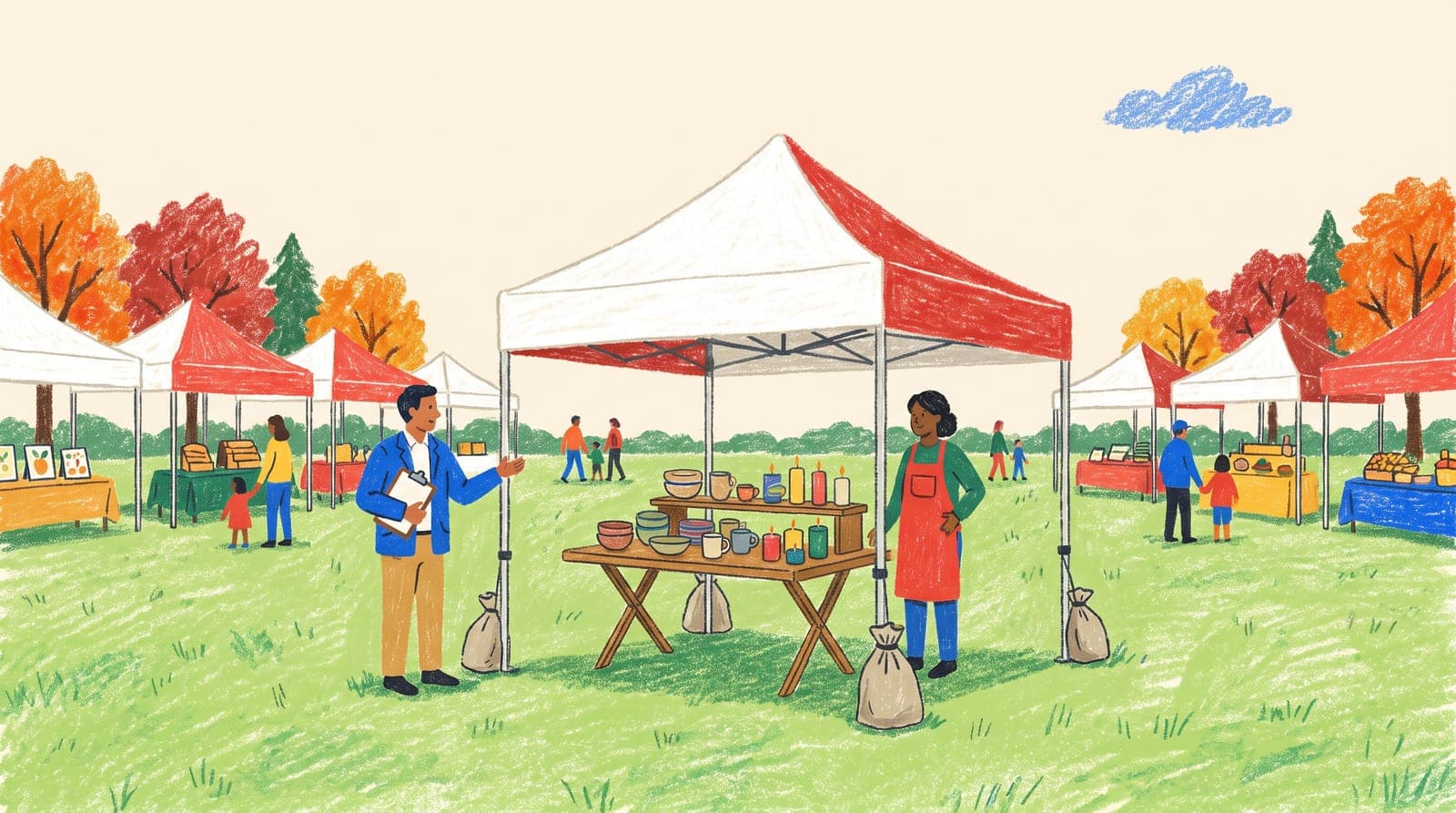
Somewhere on a vendor application, usually near the bottom, there is a line that says "proof of insurance" or "certificate of insurance naming the organizer as additional insured." First-time sellers ask the same three questions about it: what is it, do I actually need it, and how much should it cost?
I build Vendorbound so vendors can know what an event costs before they apply, and insurance is part of that cost. This guide answers the questions sellers ask on Reddit and in search, with prices taken from the insurers' own pages on October 2, 2026, quotes from vendors who bought policies, and a count of how many events in the Vendorbound catalog ask for it.
The short answer
- What it is. "Vendor insurance" is general liability insurance sized for booths: it pays if a customer trips in your space or your tent damages someone else's. Annual policies usually add product liability, which covers harm from what you sold.
- Do you need it? Not by law in most cases, but often by the organizer. In a random sample of 600 events in the Vendorbound catalog, 100 listed insurance as required, including 27 of 87 farmers markets.
- What it costs. About $49 for a one-to-three-day event policy, or $24 to $26 a month ($279 to $299 a year) for an annual plan from the big online providers for crafters and food vendors.
- What organizers ask for. Usually $1 million per occurrence and $2 million aggregate, with the event named as an additional insured on your certificate.
- The catch. One-day policies from ACT and Insurance Canopy do not include product liability. If you sell candles, food, or skin care, that is the coverage that matters most.
What vendor insurance is, and what it is not
"Vendor insurance" is not one product. It is a bundle, and the pieces matter because organizers ask for specific ones.
General liability covers injuries and property damage you cause at the event. The examples vendors give are the same every time: a customer trips over a tent leg, a display falls on a child, wind lifts a canopy into the next booth. One r/CraftFairs vendor described a flea market where "a gust of wind picked up an ez-up and when it came down, it damaged another vendors arm. Three stitches and $12,000 in expenses to the owners tent."
Product liability (insurers call it "products and completed operations") covers harm from what you sold after it leaves your booth: a candle that starts a fire at home, a food that makes someone sick, a balm that causes a reaction. As one candle maker put it, "General liability and product liability are not the same."
Theft and damage (sometimes called inland marine) covers your own tent, displays, and inventory. It is an add-on almost everywhere: ACT charges $4.50 a month on its annual plan, and Insurance Canopy charges $54 on top of a one-day policy.
A certificate of insurance (COI) is the one-page proof you send the organizer. It lists your insurer, your limits, and who else is covered. ACT, FLIP, Insurance Canopy, and Next let you download one as soon as you pay.
What vendor insurance does not cover: your car or food truck on the road (that is commercial auto), employees who get hurt (workers' compensation), or lost sales from a rained-out weekend.
Do you need insurance to sell at a craft fair or farmers market?
Usually not because of a law. Next Insurance, which sells these policies, says so directly: "Commercial general liability coverage isn't typically required by law. However, some clients and event venues could ask for a certificate of insurance." The requirement comes from the organizer, the venue, or the city that issues the event permit.
How often it comes up depends on the event. We pulled a random sample of 600 events from the Vendorbound catalog on October 2, 2026, out of 20,076 listed, and read what each one publishes for vendors:
| Event type | Insurance listed as required |
|---|---|
| Farmers markets | 27 of 87 (31%) |
| Festivals | 40 of 211 (19%) |
| Community events | 10 of 80 (13%) |
| Holiday markets | 6 of 76 (8%) |
| All 600 events | 100 (17%) |
Another 18 events said insurance was recommended but optional. These are floors, not ceilings: some organizers only mention insurance in the acceptance email.
Vendors report the same split. "Out of all shows I've done, fewer than 1/4 asked for insurance," one wrote. Another said: "Big shows tend to require insurance. Smaller normal shows generally don't care. We only got a policy once we started moving into the +$350 events that required it." A third had vended for eight years without it "and only started paying for it last year when more and more events started requiring it."
Farmers markets are the most likely to ask. The Farmers Market Coalition tells market managers that "many farmers markets also require their vendors to have their own liability policies," and some require product liability from everyone: the Klamath Falls Farmers Market in Oregon says "all vendors must carry appropriate product liability insurance." Others carry a policy for the whole market, so before you buy anything for a small market, ask the organizer what their coverage includes.
What you sell changes the answer even when the event does not require it. The Chatham Fall Craft Festival in Massachusetts only requires a certificate from exhibitors selling consumable goods: "food, candles, personal care, aromatherapy and similar." If you sell those, plan on insurance either way. Our candle business guide covers the rest of a candle maker's setup.
How much does vendor insurance cost?
These are the published starting prices on October 2, 2026, for vendors selling at events. Your quote depends on your state, product, and sales, so treat them as the floor.
| Provider | Policy | Price | Product liability |
|---|---|---|---|
| Insurance Canopy | One event, 1 to 3 days | $49 | No |
| Insurance Canopy | One event, 7 days | $99 | No |
| Insurance Canopy | One event, 90 days | $149 | No |
| Insurance Canopy | Annual | From $24.25 a month | Yes, $2M |
| ACT (ACT Go) | One event, 1 to 3 days | $49 | No |
| ACT (ACT Pro) | Annual, crafters | $24.25 a month or $279 a year | Yes, $2M |
| ACT Pro for handmade beauty | Annual, soap, cosmetics, and candle makers | $515 a year | Yes |
| FLIP | Annual, food vendors | $25.92 a month or $299 a year | Yes, $2M |
| The Hartford | Standalone general liability, craft vendors | $810 a year (customer average) | Varies |
The general liability limits on the online policies are the same across the board: $1 million per occurrence and $2 million aggregate.
What vendors say they actually paid lines up with those numbers, with a wide spread on either side:
- ACT annual: "$250 for the year," or "$50 for a weekend."
- FLIP for a food vendor: "I pay $27 a month."
- The Handcrafted Soap and Cosmetic Guild for a candle maker: "a million dollar general and product liability policy that works out to about $38/Mo."
- Thimble: "about 400-450 a year."
- Next, monthly: "It comes out to $31 with fees." Next for one day: "$70 for one day is crazy."
- State Farm, through an existing agent: $350 a year, later cut to $250 for $2 million.
Prices also move. One vendor wrote in August 2026: "Last year I paid 20 bucks or so for a one day small event outdoors. This year, that same company wants over 100 dollars." If a quote looks high, check two more before you pay. When a food vendor was quoted $250 a month on FLIP, the reply from another vendor was "That sounds like an error."
Some events sell coverage themselves. The Washington County Fair in Oregon lists the option to buy insurance through the fair for $165, more than three times the price of a one-event policy from ACT or Insurance Canopy.
One-day policy or annual: the break-even
At ACT's prices, an annual policy at $279 costs less than six one-event policies at $49 ($294). Insurance Canopy's numbers land in the same place. So if you will do six or more separate events in the next 12 months, the annual plan is cheaper on price alone.
Two details push the break-even lower:
- Event policies cover consecutive days only. ACT says that "if your shows fall on separate weekends, you'll need a separate policy for each." A weekly farmers market is a new event every week unless you buy a longer term.
- Event policies leave out product liability. Insurance Canopy states it plainly: "one-day vendor insurance does not include product liability coverage. Only our annual vendor insurance plans offer product coverage." ACT Go is the same. If the organizer asks for product liability, as Candia Farmers Market in New Hampshire does ("$1,000,000 per occurrence general and product liability"), a one-day policy does not meet the requirement.
A one-day policy makes sense for a single show that requires general liability, where you sell something that is unlikely to hurt anyone after the sale: prints, crochet, jewelry from known metals. For food, candles, and anything applied to skin, the annual policy is the one that actually covers your product.
What the certificate has to show
Organizers check three things on a certificate: the limits, who is named, and the dates.
Limits. The common request is $1 million per occurrence. Of the 100 sampled events that required insurance, 29 stated $1 million in their published rules and 3 mentioned $2 million. A few ask for less: Dog Daze in Florida asks for $300,000. If an event wants more than your policy carries, FLIP and others sell excess liability in $1 million steps.
Additional insured. Of the 100 events that required insurance, 41 mentioned an additional insured in their published rules. That extends your policy to cover the organizer if they are sued over something that happened in your booth. The Farmers Market Legal Toolkit explains why markets ask: when a customer sues, they usually sue the vendor, the market, and the property owner together. Examples of the exact wording from catalog events:
- Brentwood Farmers' Market, California: "General liability insurance of $1,000,000 with PCFMA listed as additionally insured."
- Washington County Fair, Oregon: "$1,000,000 per occurrence and $2,000,000 aggregate with an Additional Insured Endorsement naming Washington County and the Washington County Fair Board."
- Illumination Holiday Festival, California: a certificate naming the City of Elk Grove as certificate holder, "plus a separate Additional Insured endorsement page."
Copy the organizer's exact legal name into the additional insured field. Elk Grove, for example, wants "The City of Elk Grove, its officials, employees, agents and volunteers" listed, not only the festival's name.
What adding one costs. ACT, FLIP, and Insurance Canopy include free, unlimited additional insureds on their policies. Other insurers charge per name: the Farmers Market Legal Toolkit cites "$30 to $50 per additional insured," and vendors report $20 per certificate at some brokers. At 15 events a season that can add $300 to $750, so ask about it before you buy.
Certificate holder versus additional insured. A certificate holder only receives a copy of your proof. An additional insured is covered by your policy. The Farmers Market Legal Toolkit notes that "a certificate holder is not necessarily an additional insured, and vice versa." When an application asks for both, as Elk Grove's does, you need both.
Dates. Event policies cover the dates you enter, so include setup and teardown days. Insurance Canopy's 1-to-3-day policy is priced to include them.
Does homeowners or renters insurance cover your booth?
Usually not. The National Association of Insurance Commissioners, the organization of state insurance regulators, says that "coverage for business-related property losses or liability exposures is typically excluded from a traditional homeowners policy." It suggests a business endorsement or a separate business policy instead.
That is the route several vendors took: they asked the company that already insures their home or car to write a business policy. One paid "about $360 for the year with $1M" that way, after finding that the temporary policies their larger fairs required cost "about $125 an event." The benefit is a single agent; the cost is often a fee each time you add an event as additional insured. That same vendor pays "$20 to add them on."
Who will not insure you
The crafter insurers do not cover everything. A blacksmith wrote that ACT "won't insure me," and a food vendor in the same thread said "If you're selling foods, ACT won't cover you properly." The split the Farmers Market Coalition uses is a good starting point: FLIP for food, ACT for non-food.
Candles, soap, and cosmetics sit in between. ACT prices them separately at $515 a year, and candle makers on Reddit name the Handcrafted Soap and Cosmetic Guild, Thimble, Next, and The Hartford as their insurers. A truck or trailer on the road is a separate policy, commercial auto. The kettle corn business guide covers the permit side of food at events.
What insurance does not replace
The incident vendors describe most often is wind and a tent. Insurance pays for the damage after the fact. The vendors who have seen it happen recommend preventing it first: "40+ pounds per leg minimum" of tent weight. Some events state their own minimum in the vendor rules, so check before you load the car.
And some events let you sign instead. Harvest Fest in Homer City, Pennsylvania, accepts a $1 million certificate "or sign the waiver of liability at check-in." A waiver protects the organizer, not you, so it does not replace your own coverage.
Where to sell once your COI is ready
Live from the Vendorbound catalog
2,287 farmers markets are taking vendor applications now
3,192 in the catalog. Where there are the most:
- Farmers markets in California385 open
- Farmers markets in Florida188 open
- Farmers markets in Texas161 open
- Farmers markets in New York97 open
- Farmers markets in Pennsylvania81 open
- Farmers markets in Ohio80 open
Farmers markets were the most likely to require insurance in our October 2026 sample, so if you are applying to weekly markets in California or Texas, have your certificate ready before you apply. County fairs such as those in Oregon often ask for an additional insured endorsement by a fixed date.
Frequently asked questions
How much is vendor insurance for one day?
From $49 for a one-to-three-day event at Insurance Canopy and ACT, as of October 2, 2026. That buys $1 million per occurrence and $2 million aggregate general liability, without product liability. One vendor reported paying $70 for a single day elsewhere.
Do I need insurance to sell at a farmers market?
Not by law in most states, but many markets require it. In our sample of 600 catalog events, 27 of 87 farmers markets listed insurance as required, the highest share of any event type. Some require product liability from every vendor.
What does vendor insurance cover?
General liability covers injuries and property damage you cause at the event, such as a customer tripping in your booth. Annual policies usually add product liability for harm from what you sold. Your own tent and inventory need a theft and damage add-on.
How do I add an event as an additional insured?
Log in to your insurer's dashboard or call your agent, enter the organizer's exact legal name and address, and download the new certificate. ACT, FLIP, and Insurance Canopy do this free. Some insurers charge $20 to $50 per name.
Is it cheaper to buy insurance per event or for the year?
At $49 an event against $279 a year, the annual policy is cheaper from the sixth event on. It also adds product liability, which one-day policies from ACT and Insurance Canopy leave out.
Does my homeowners insurance cover me at a craft fair?
Usually not. The National Association of Insurance Commissioners says business liability is typically excluded from homeowners policies. Ask your insurer for a business endorsement or a separate business policy.