Canopy weights: how much weight a vendor tent needs, and what events require
Canopy weights by the numbers: 40 pounds per leg is the most common rule in 408 event listings. What to buy or build, and how to tie it on.

Agustin Garcinuño13 min read
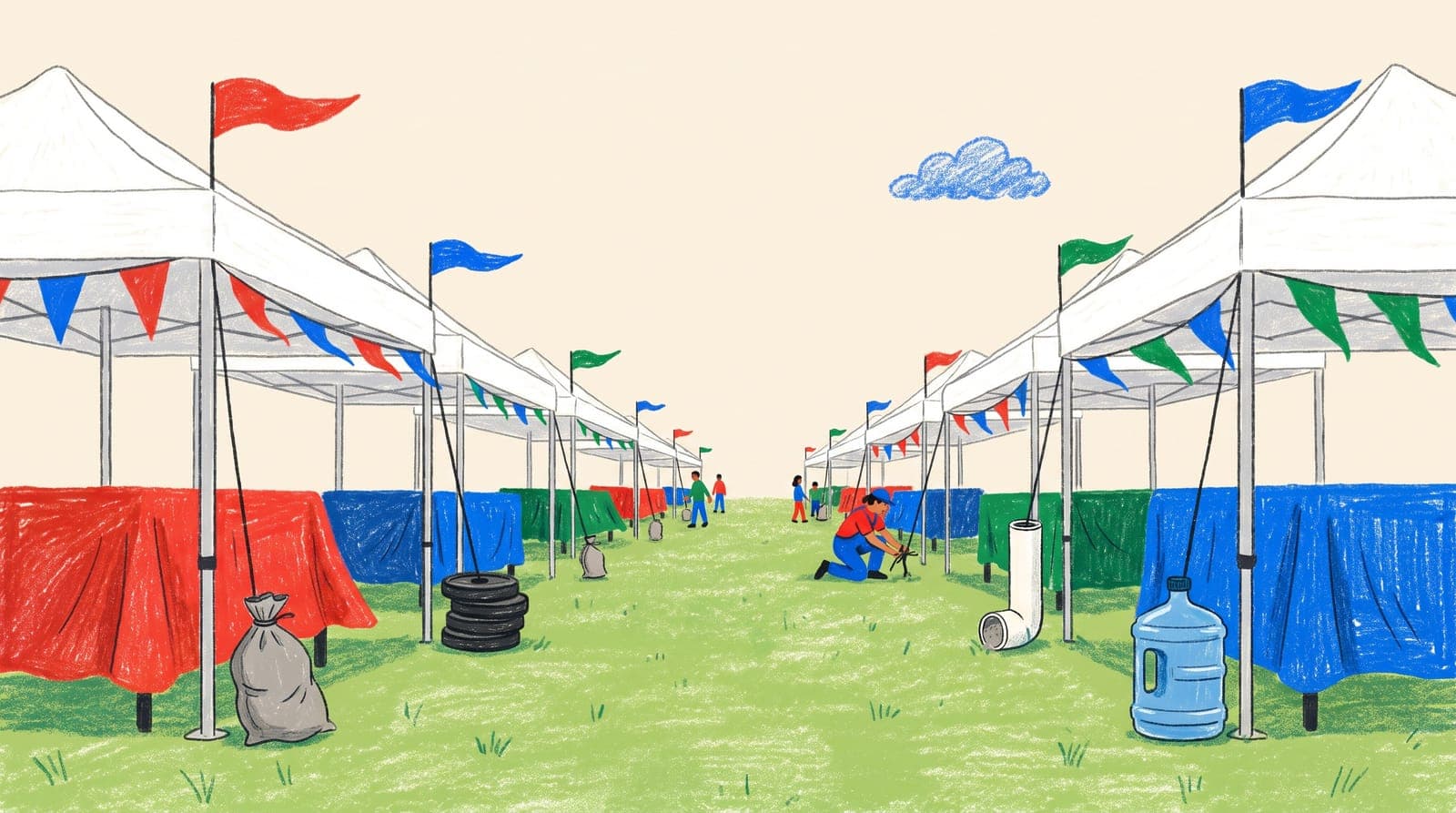
I grew up working my family's mini donut stand at fairs and farmers markets across Humboldt County, and outdoor events all share one risk that has nothing to do with sales: wind. A pop-up canopy acts like a sail, and the weights on its legs decide whether it stays in your booth or lands in someone else's.
This guide answers the question vendors ask before their first outdoor show and again before every windy one: how much weight is enough? It uses three kinds of sources. The first is the rules: we read the vendor requirements of 13,538 festivals, farmers markets, holiday markets and street fairs on Vendorbound and counted what they ask for. The second is the regulators and manufacturers who publish a number. The third is vendors who have lost a tent, or watched one go, in their own words.
The short answer
- Plan on 40 pounds per leg, 160 pounds for a 10x10. It's the most common rule in the event listings we counted (146 of 408 that name a figure), and the minimum the city of Zionsville, Indiana and Columbia, Missouri set for a 10x10.
- Festivals ask for more than farmers markets. The middle festival rule is 40 pounds per leg; the middle farmers market rule is 25.
- A gallon jug of water is not a tent weight. It's about 8 pounds; 5 gallons make 40. Some events ban disc weights and stakes outright, so read the rules first.
- Tie each weight to the top of the frame, not only the foot. Zionsville asks for weights attached "with a sturdy strap or rope to the frame of the canopy."
- The cheapest 40 pounds is a bucket of concrete. An 80-pound bag of concrete mix was $6.47 and a 5-gallon bucket $3.98 at Home Depot on October 2, 2026. Bought bags start at $59 for four, sand not included.
How much weight a 10x10 canopy needs
The regulators who publish a number agree on 40 pounds per leg for a small canopy. Zionsville says a 10x10 "can be effectively anchored with a minimum of 40 pounds of weight per leg." Columbia, Missouri requires "a minimum of 40 pounds of weight or 2 stakes per leg" for each 10x10 or 12x12. The Loudoun County Sheriff's tent permit flyer sets "Forty (40) pounds weight per leg as a minimum for smaller tents."
Manufacturers who sell canopies give ranges that start lower on calm days and climb fast with wind:
| Source | Calm day | Windy day |
|---|---|---|
| Instent | 15 to 20 lb per leg | 40 to 50 lb per leg on hard ground, 60 or more in gusts |
| Westshade | 15 to 25 lb per leg (0 to 10 mph) | 50 to 75 lb per leg (15 to 25 mph) |
| TentCraft | At least 200 lb total on concrete for its 35 mph wind rating |
Vendors land in the same place. "Read the forecast, assume it will be worse, minimum 20 lbs per leg for calm days, and more for anything over a light breeze," one r/CraftFairs vendor wrote after their tent held, on 50 pounds a leg, through a day with 25 to 50 mph gusts in the forecast. In a TikTok video, @criteschaosncharm put it bluntly: "You need 40 pounds minimum on a tent. Not all together, per leg."
The trouble is that 40 pounds per leg is 160 pounds to lift in and out of a car before you've unpacked any stock. That's why so much of the advice below is about splitting the weight into pieces you can carry.
What events require: 408 vendor rules counted
On October 2, 2026, we read the vendor rules of 13,538 events on Vendorbound: every festival, farmers market, holiday market and street fair with a published listing, plus a few hundred others. 1,285 of them mention tent or canopy weights. 408 name a per-leg figure. Where a listing gave more than one number, we counted the lowest.
| Pounds per leg | Events | Share |
|---|---|---|
| Under 20 | 22 | 5% |
| 20 to 24 | 46 | 11% |
| 25 to 29 | 104 | 25% |
| 30 to 39 | 49 | 12% |
| 40 | 146 | 36% |
| 41 to 49 | 8 | 2% |
| 50 or more | 33 | 8% |
Nearly half (187 of 408) ask for 40 pounds or more. The rule depends on the kind of event:
- Festivals: 205 listings name a figure, and 134 of them ask for 40 pounds or more. The FoodeesFest in Daytona Beach asks for "40 lb minimum weights per leg." The Itty Bitty Ren Faire in Camden, South Carolina wants 50 pounds per leg "per Fire Marshal," and the Northglenn Artisan Market in Colorado asks for 50 to 75, "verified by the fire marshal."
- Farmers markets: 133 listings, and the middle one asks for 25 pounds. Only 23 ask for 40 or more, like the Mechanicsburg Sunday Market in Pennsylvania, which also bans stakes.
- Holiday markets: 53 holiday market listings name a figure, and the middle one is 30.
- By state: Colorado's listings are the strictest. 31 of the 32 that name a figure ask for 40 pounds or more. Florida has the most listings with a figure, 80, and about half of them ask for 40 or more.
Some rules are about the kind of weight, not just the pounds. At least 103 listings say stakes are not allowed, usually because the event is on pavement or turf. At least 14 ban disc weights, like the Sun Valley Commons Fall Festival in North Carolina. The Wendell Underground Market asks vendors to certify they have 20-pound sand bags on each corner and to upload a photo of them. The Hudson Valley Open Market wants each 25-pound weight "suspended just above ground."
Organizers set high numbers on purpose. "We require 50lbs per leg. Most years this feels like overkill," wrote one r/CraftFairs member who runs an art market at a festival. "We always have artists complain that other festivals require 20 or 30lbs per leg and they're always fine."
If you forget your weights, a few events rent them. First Friday at Baldwin Park in Orlando rents them on site for $20, and Northglenn offers a tent and weight rental add-on for $75. Most don't, so they go on the vendor checklist every time.
10x20 and 12x12 canopies
A bigger canopy has more fabric for the wind to push on, so it needs more weight in total, and a 10x20 has six legs to share it. TentCraft says its 10x20 needs 370 pounds to reach its 35 mph wind rating, about 62 pounds per leg, compared with 200 pounds for its 10x10. Westshade suggests at least 60 pounds per leg for a 10x20 in wind. Regulators that give a 10x10 figure usually say a bigger tent needs more without giving a number; Loudoun County asks for 40 pounds per leg "as a minimum for smaller tents."
A 12x12 is still in the small-canopy rule in Columbia, Missouri: 40 pounds or two stakes per leg. Past that size, the fire code takes over. Nashville requires a permit for canopies of 400 square feet or more, and Zionsville applies the state fire code once the canopies at a public event add up to more than 400 square feet.
Side walls count too. A wall turns the canopy into a box that catches wind from the side. TentCraft's wind ratings apply only to a tent "with no walls," and Westshade suggests at least 50 pounds per leg for a 10x10 with sides. One vendor using a 10x20 with no walls wrote: "I've done 40 pounds a leg on windy days, and still had to stand on opposite corner of husband to keep it under control."
Canopy weights you can buy, and what they cost
Bought weights come in three shapes. Prices are from the sellers' sites on October 2, 2026.
- Fill-yourself bags wrap around the leg with Velcro or buckles. E-Z UP's 25-pound weight bags are $59 for four, and its Deluxe Weight Bags, which hold up to 45 pounds of sand or gravel each, are $109 for four. Sand isn't included; a 50-pound bag of play sand was $4.47. Some vendors pour the sand into zip-top bags first, because, as one put it, "I didn't want sand loose anywhere."
- Stackable plates slide around the foot of the leg. E-Z UP's cast-iron Weight Plates are 22 pounds each, sold in packs of two or four, from $105. Lighter disc weights are common too: the horseshoe-shaped ones "are 5lbs each so you would need 10-15 per leg," a vendor pointed out, and some events ban discs.
- Water-fill weights are light to carry home empty. In a TikTok video, @crescentsunstudio explained: "If you fill them with water, they weigh about 22 pounds. And if you fill them with sand, they weigh about 30 pounds." Either way that's short of 40, so plan on two per leg.
Gym weights work if they're tied on. In a video, @blossomflowerherbals describes using kettlebells: "I do the kettlebells, 35 pounds per leg. You could even do 45 pounds per leg. Ratchet strap to the top frame of the tent all the way down to that kettlebell." In a TikTok post, @carolinahookandyarn uses "four ten-pound plates per leg for forty pounds per leg." Loose plates sitting on the foot don't count at events that only accept weights secured to the canopy.
DIY canopy weights: buckets, PVC pipe and cinder blocks
Most vendors who sell outdoors every week end up making their own. Florida International University's safety office publishes tent anchoring instructions with the two common builds:
- A bucket of concrete. Fill a 3.5-gallon bucket with concrete mix to 6 inches below the lip, and set an eye bolt with washers and a nut in the center before it hardens. Tie a rope from the eye bolt to the top of the frame. Don't use the bucket's own handle: "It'll rip out," one vendor warned.
- PVC pipe filled with concrete or sand. Cap one end of a 3 or 4 inch pipe, fill it, and set an eye bolt in the top. FIU suggests making "8 pipes that weigh 20 pounds each (i.e. two weights for each leg) instead of 4 pipes that weigh 40 pounds" because they're easier to carry. One vendor's 4-inch pipes, 2 feet long, weigh 35 pounds each. White pipe blends in with a white canopy, and some higher-end art shows won't allow buckets for looks.
The cost is mostly concrete. At Home Depot's online prices on October 2, 2026, an 80-pound bag of concrete mix was $6.47 and a 5-gallon bucket $3.98, before eye bolts and rope.
Cinder blocks are the shortcut, with a catch: TentCraft says concrete blocks "tend to weigh under 30 pounds, which isn't enough" on their own on a windy day. A gallon jug of water is worse at about 8 pounds. The Keystone Festivals guidelines put it plainly: "Gallon water jugs and single bricks are not safe."
How to attach canopy weights so they hold
A weight resting on the foot of a leg holds the foot down. It does nothing to stop the canopy from lifting at the top, twisting, and folding the leg. That's why the rules say to tie it to the frame. Zionsville asks for weights attached "with a sturdy strap or rope to the frame of the canopy in a manner to limit movement of the support legs," and the Keystone guidelines want each weight secured "to canopy roof and to canopy leg separately."
The way most vendors do it:
- Set the weight against the foot of the leg, inside the booth so nobody trips on it.
- Run a ratchet strap or rope from the weight up to the corner of the frame where the leg meets the truss, and pull it snug.
- Wrap a strap or Velcro around the weight and the leg so it can't swing.
If you use disc weights, stagger them so the slots face opposite ways and lock together, then strap the bottom one to the frame. This vendor does it with "dinky" 10-pound discs because buckets are too heavy for them to lift: "This gives you 40-50 lbs on the leg, and the ratchet tie down, while still keeping the weights at a point that you can move them."
Not everyone ties to the top. One vendor found that "a steady wind will cause legs to break at the attachment point if you attach to the top" and switched to sandbags on the feet. Doing both, a weight on the foot and a strap to the frame, covers each failure.
Stakes or weights?
On grass, stakes can do the job, and some rules accept them in place of weights: Columbia, Missouri allows "2 stakes per leg" instead of 40 pounds. TentCraft's engineers count a properly installed stake as equal to 200 pounds of weight.
But many events can't take stakes. At least 103 listings we read say stakes aren't allowed, on pavement, on park turf, or because of buried utilities, which is the reason FIU bans them on campus. Bring weights to every outdoor event, and bring stakes too when the event is on grass and allows them.
When the wind is too strong to put the tent up
Weights buy you time; they don't make a canopy windproof. Columbia, Missouri doesn't allow tents and canopies "when winds are forecasted over 20 mph." TentCraft rates its heavy-duty 10x10 for 35 mph when fully anchored and doesn't recommend using it above 40.
Vendors who have been through it set their own limit lower. "Even with 50 lbs of weight keeping each leg in place, the whole top can get twisted and destroyed in high winds," one wrote. "Basically if I need more than 35 lbs on my tent legs, my tent ain't going up, and I'm probably not doing the event." Another, with "35-40 lb weights on all 4 legs," watched the tent move back a couple of feet when a storm arrived early. On video, @crochetbyashton reported: "My tent blew away overnight at a vendor event, even though it had more than 400 pounds weighing it down."
A loose tent rarely hurts only its owner. "I was at a market today that was so windy that a tent with weights took out my ceramics costing me nearly $500 in value," one vendor wrote about someone else's canopy. Damage your canopy does to someone else's booth is what general liability insurance is for; damage to your own tent and stock needs separate coverage. The vendor insurance guide explains the difference.
Where to find outdoor events now
Live from the Vendorbound catalog
5,268 festivals, farmers markets, street fairs and more are taking vendor applications now
10,922 in the catalog. Where there are the most:
- Festivals in Florida408 open
- Farmers markets in California370 open
- Festivals in Texas252 open
- Festivals in California220 open
- Farmers markets in Florida185 open
- Farmers markets in Texas159 open
On October 2, 2026, 1,285 of the 13,538 event listings we read mentioned tent weights, so check the vendor rules on the event page before you pack. Festivals in Colorado and Florida are where the 40-pound rule shows up most.
Frequently asked questions
How much weight do I need for a 10x10 canopy?
Plan on 40 pounds per leg, 160 pounds in all. It's the minimum several cities, like Zionsville, Indiana, set for a 10x10 and the most common rule in the 408 event listings we counted that name a figure. On a calm day at an event that allows less, 20 to 25 pounds per leg is the low end.
Is 20 pounds per leg enough?
On a calm day, often yes, and 46 of the listings we counted set 20 pounds, like the Wendell Underground Market. But it's below what most festivals ask for, and vendors who have lost tents use 35 to 50. If the forecast shows gusts, add weight or keep the canopy down.
Are gallon water jugs enough to hold down a canopy?
No. A gallon of water weighs about 8 pounds, so you'd need five per leg to reach 40. Some event guidelines name gallon jugs as unsafe. One vendor's water-fill weights hold about 22 pounds of water or 30 of sand, so plan on two of those per leg.
Do I need weights if I stake my tent?
Sometimes not: Columbia, Missouri accepts two stakes per leg instead of 40 pounds. But many events are on pavement or ban stakes, at least 103 in the listings we read, so bring weights to every outdoor event and use stakes as well where the ground and the rules allow them.
How much weight does a 10x20 canopy need?
More in total, spread over six legs. TentCraft says its 10x20 needs 370 pounds to reach its wind rating, about 62 pounds per leg, and Westshade suggests at least 60 pounds per leg in wind. Add more if you use side walls.
Can I rent tent weights at the event?
A few events rent them, like First Friday at Baldwin Park in Orlando for $20, but most don't. Treat weights like the tent itself: if you don't bring them, you may not be allowed to set up.
More guides
Selling at markets
Vendor insurance for markets and fairs: what it covers, what it costs, and the COI
Start a business
Florida cottage food law: what you can sell, the $250,000 cap, labels, and markets
Start a business
Michigan cottage food law: the new $50,000 cap, what you can sell, labels, and markets