How to start a permanent jewelry business: kit costs, pricing, and pop-up events
How to start a permanent jewelry business for pop-ups and markets: welders from $997, the bracelet prices artists post, and why some events turn it away.

Agustin Garcinuño13 min read
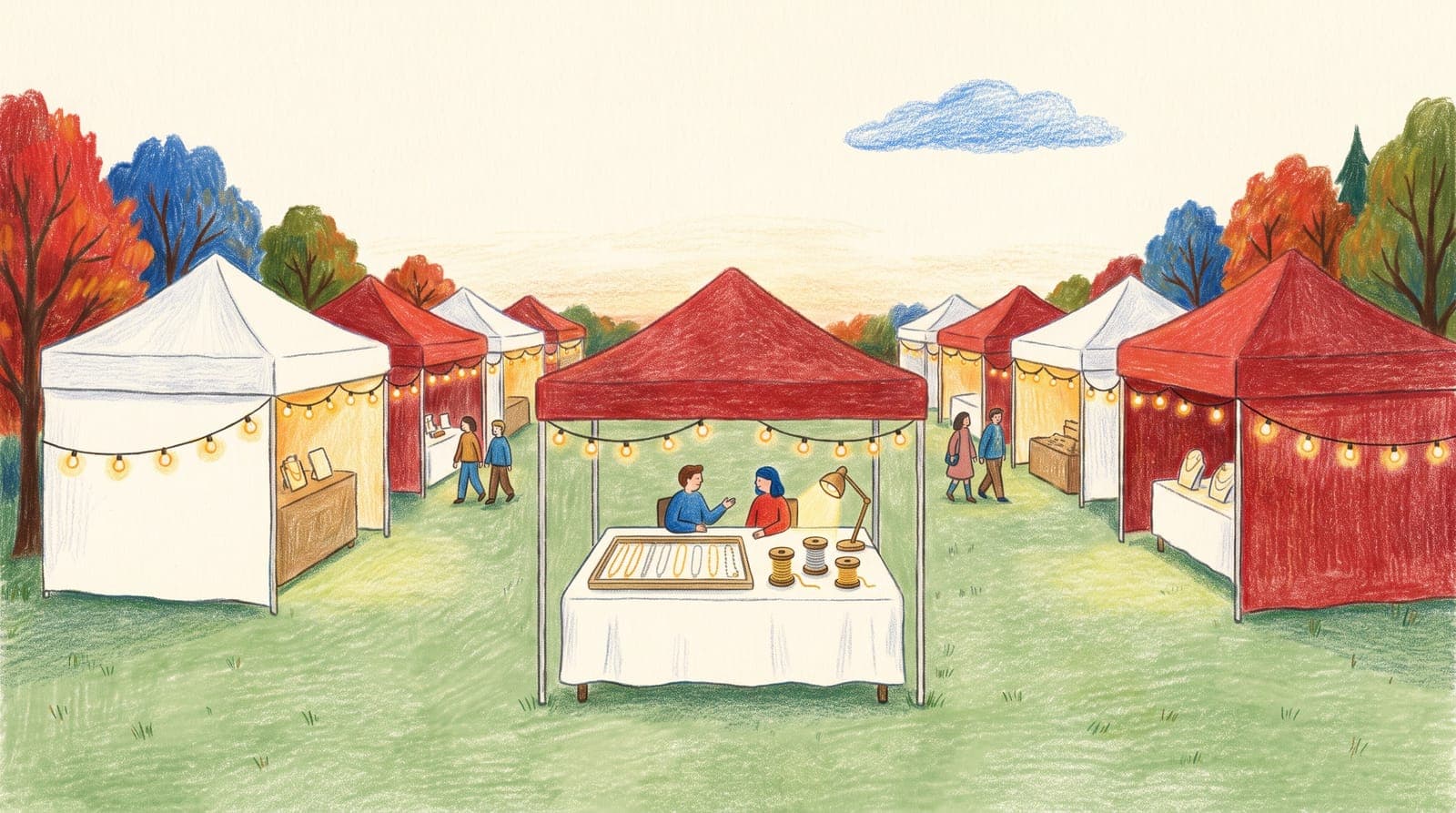
Permanent jewelry is a chain bracelet, anklet or necklace with no clasp: the artist sizes it on the customer and welds the last link shut with a small pulse-arc welder. It's a service more than a product, which is why it fits pop-ups, night markets and holiday markets so well. People walk up, pick a chain, sit down, and leave wearing it 15 minutes later.
It's also one of the most crowded categories at markets right now, and some organizers don't count it as handmade. This guide covers what the equipment costs, how artists price a bracelet, how many customers one event can hold, what you need for power and safety, and which events take permanent jewelry and which don't.
The short answer
- Startup cost: welders alone run from $997 to $2,850, and starter kits with welder, chain and training from $2,399 to $4,999 (prices checked October 6, 2026). One artist on video put their total at $6,000 with inventory.
- Price: artists post gold-filled bracelets from about $50 to $75 at pop-ups, with anklets and charms on top. Many price by the piece, not by the inch.
- Speed: a full appointment takes about 15 to 20 minutes, so a new artist sees two or three customers an hour.
- Events: of 55 upcoming or recurring event listings in our catalog that mention permanent jewelry, 12 exclude it, say the category is full, or take it by invitation only.
- Licensing: we found no state board that licenses welded bracelets. Organizers are the ones who ask for insurance and signed waivers.
- Power: many outdoor and night markets have no outlet, so artists bring a battery welder or a portable power station.
How a permanent jewelry booth works
The setup is small: a tabletop welder with a stylus and grounding clip, chain on spools or display boards, jump rings, cutters and pliers, a tray of charms, a leather patch that goes between the chain and the skin, and eye protection for the welder. The customer sits across a table with a wrist rest. You measure, cut, close the jump ring, weld, and check the fit.
One outdoor market booth shown on TikTok by @keyandco.jewelry (May 28, 2026) used a white canopy, covered folding tables, a rug, overhead string lights, upright chain boards, charm trays, a customer chair, a magnifying task light, a wrist rest and a clipboard of consent forms. The artist described the first steps of the setup: "To start off the glow up, I added the rug to make it feel more warm, cozy, and welcoming. Next, I added the lights to brighten up the space."
Most of the work happens before the weld. Customers pick a chain and decide whether to add a charm, and that choice takes longer than the weld itself. One studio, @fuzedjewelry, says "most of our appointments are 15 minutes or less", and the weld itself takes seconds.
What it costs to start: welder, chain and training
The welder is the big purchase. Here are the prices posted on sellers' sites on October 6, 2026:
| What you buy | Price | Source |
|---|---|---|
| LINKED Luxe welder, machine only | $997 | LINKED |
| Sunstone Zapp welder, machine only | $1,249 | Sunstone |
| Helix welder, machine only | $1,449 | LINKED |
| Orion mPulse 2.0 welder, machine only | $2,850 | LINKED |
| Sunstone starter kits (welder, 21 to 45 feet of chain, tools, training) | $2,399, $3,199, $4,999 | Sunstone |
| LINKED kits with training, by welder | $2,997 to $4,997 | LINKED |
| Everlinx kit, plug-in or battery welder | $2,999 or $3,299 | Everlinx |
| Chain starter kit, no welder (10 chains, 30 feet, "about 50 bracelets") | $649 | Pretty Pickie |
| Online training course only | $349 | Shay Danielle |
| In-person technical training, full day | from $1,000 | Golden Bond |
A few things the table doesn't show:
- Chain is your inventory. The $649 chain kit works out to about $13 of chain per bracelet. Buying chain by the spool costs much less per inch: one supplier's pricing guide puts quality gold-filled chain at $0.15 to $0.25 an inch wholesale, or about $1 to $2 for a seven-inch bracelet.
- Training varies more than welders do. One artist said on video that they "paid $3,000 to start my permanent jewelry business" through a trainer, and later judged the chain included: "that trainer probably only gave me around $200 to $300 worth of material, honestly, maybe even less because it wasn't even gold filled, it was probably just gold plated." Ask what metal the kit chain is, and how many feet, before you pay.
- You may not need the top welder. An artist who owns one put it plainly: "You don't need a $2k+ welder". Another said of an entry-level machine: "For $1,000 this machine is definitely worth it."
- Argon is optional. LINKED says each of its welders "accepts argon, but none of them require it".
Add the event costs on top: booth fees, an outlet fee or a power station, a canopy and weights for outdoor markets, a card reader, and insurance. For @salt.bond, the total came to "$6,000, so that included my starter kit and then all of the chains and charms I had to buy for my inventory".
How permanent jewelry artists price a bracelet
Many artists set a flat price per piece by chain tier. One artist, @heavenlylinked, explained their three tiers on video: "for a ring, it'll be 25, 65 for a bracelet, 75 for an anklet," then $70 and $80 for the second tier, and "75 for a bracelet, and 85 for an anklet" on the third.
Other prices artists and studios post:
- Pop-ups: one artist's booth sign read "PERMANENT JEWELRY STARTING AT $50" (@fuzedbybre, August 22, 2026). The same artist advertised bracelets from $25 at an earlier two-day pop-up.
- Studios: a studio in the Washington, DC area says most clients pay $85 to $155, with most charms at $25 to $35. Another lists gold-filled bracelets at $65 to $115 and sterling at $35 to $115.
- Re-welds: $10 when a customer's chain breaks and they come back (@fuzedbybre).
Per-inch pricing exists (one supplier's example is $30 plus $5 an inch, or $65 for seven inches), but the same guide recommends flat rates at pop-ups because there's no math at the chair. It also gives a rule many artists use for other pieces: "anklet = bracelet price + $15". Underpricing has a cost too. An artist who charged $50 at a pop-up said "that's literally really cheap for a permanent bracelet" and still sold nothing that day.
For the general method of building a price from materials, time and booth fees, see how to price handmade items. The difference here is that chain is a small share of the price, and your time at the chair is most of it.
How many customers one event can handle
The appointment length sets your ceiling. At 15 to 20 minutes each, one supplier's guide puts new artists at two to three appointments an hour and experienced ones at three to four. At $70 a bracelet, that's roughly $140 to $280 an hour before costs. A training company claims its students see "4-6 customers per hour"; treat a seller's number as a ceiling, not a plan.
What artists post about real events is more uneven. One artist shared three markets, each with a $125 fee (@fuzedbybre, August 22, 2026):
| Market | Sales | After the $125 fee |
|---|---|---|
| One | one $10 re-weld | lost $115 |
| Two | 12 pieces and two re-welds, $795 | $670 |
| Three | six pieces and one re-weld, $370 | $245 |
Good days happen. One studio, @snhlinked, posted that "We linked 90 mothers & daughters in one day". The same studio, at a different event, wrote: "When you do everything right... and still make $0. We paid a vendor fee, we paid our linker... Once you add the vendor fee and the payroll, yes, we took a loss." Another artist filmed an empty room: "I paid to be here at this event. Not a single soul walked in. I lost money."
Before you pay a fee, do the break-even. The same studio's rule: "if the vendor fee costs $350, my average customer spends around $100, I know I need about four customers to cover my cost." Then ask yourself whether that event's crowd will sit down for 15 minutes.
Power at the booth: outlet, battery welder or power station
Most welders plug into a wall outlet. Plenty of markets don't have one, and those that do often charge for it. In our count of pop-up and holiday market listings, outlets cost a median $20 (see vendor booth lighting for the full numbers and what events allow at night).
Your options:
- Pay for an outlet where the event sells one, and bring a heavy-duty extension cord.
- A battery welder. Everlinx sells a rechargeable welder it describes as "Battery powered and fully cordless", in a $3,299 kit.
- A portable power station. A supplier's guide says a Goal Zero Yeti 500X or 1000X can run a Zapp or Zapp Plus 2 for a full event, at $400 to $800 for the station. An artist who does outdoor vendor events uses a Jackery Explorer 290 and says of it: "These are nice because they don't make any noise. They do last me about three days, two to three days on the event, just welding."
- A generator, which @dolllifestudio uses for outdoor parties. Check first: many markets ban generators or allow only quiet ones.
At a night market you also need light to see a jump ring. The booths on video use a task lamp or ring light at the welding spot as well as string lights for the booth.
Licenses, insurance and waivers
We couldn't find a state licensing board that licenses welded bracelets. You'll still need what any vendor needs: a business registration where your city or county requires one, and a seller's permit to collect sales tax in your state. If you search your state's rules, you may see "permanent jewelry" in tattoo or piercing regulations. Virginia's, for example, define tattooing to include "permanent make-up or permanent jewelry, by the aid of needles or any other instrument designed to touch or puncture the skin". If you aren't sure whether a rule like that reaches your work, ask your state's cosmetology or body-art board before you start.
The rules you'll meet in practice come from organizers:
- Insurance and power. Lively Local Markets, which runs markets and festivals in Dallas-Fort Worth, tells permanent jewelry vendors they "must hold commercial insurance and provide a waiver of subrogation for Lively Local Markets and the Venue", must provide their own power, and must give buyers a warranty for materials. An event organizer on r/CraftFairs advised others booking these vendors to "make sure they have liability insurance and have their customers sign waivers". Our guide to vendor insurance covers what a policy and a certificate of insurance cost.
- Waivers. Artists collect a signed consent form before each first weld, on paper or by QR code. A supplier's safety guide suggests having a lawyer in your state review the template.
- Safety gear. Sunstone, a welder maker, says the artist places a small leather patch between the skin and the jump ring and protects their own eyes with special glasses or an auto-darkening lens. Skipping it shows: one commenter wrote that at their local market, "one of these vendors dropped molten metal on a customer."
Which events take permanent jewelry, and which don't
We searched every pop-up and holiday market listing in the Vendorbound catalog on October 6, 2026, plus the craft-named events from an October 3 pull. 66 listings mention permanent jewelry, and 55 of those are upcoming or recurring. Many list it as its own vendor category. 12 of the 55 exclude it, say the category is full or closed, or take it by invitation only. Some examples, from the listings and the organizers' own applications:
- Makers Market at First Street Napa doesn't permit permanent jewelry vendors.
- The Christmas Boat Parade Market in Newport Beach lists the category as fully booked, with a waiting list.
- The Tree City Market Holiday Bazaar in Ohio says on its application: "NO LONGER ACCEPTING PERMANENT JEWELRY VENDORS".
- Utah's Daybreak Farmers Market application says "PERMANENT JEWELRY IS FULL", and the Sunset Farmers Markets put every permanent jewelry application on a waitlist.
Others welcome it. The Jasper Farmers Market says "Permanent jewelry booths and Demo booths are also allowed." The Kris Kringle Market at Belle Grove in Virginia had closed several categories but was still taking "jewelry vendors who offer permanent jewelry".
Two things explain the limits. The first is competition: organizers cap categories, and this one fills early, as the jewelry business guide found for jewelry in general. Lively Local Markets plans "to choose 1-3 providers in this category and sign agreements with them for the entire season", and charges a fee that "starts at double the standard booth fee".
The second is the handmade question. When an organizer of a handmade expo asked r/CraftFairs about a permanent jewelry applicant, the top answer said "permanent jewelry is more of a service using manufactured chain". Another organizer replied: "Our committee recently voted to ban permanent jewelry because they don't make the base." That applicant was selling through a multi-level marketing company, which the expo's rules already banned, and most commenters said that alone settled it.
What this means when you apply:
- Apply to events that list permanent jewelry as a category or describe on-site services. Pop Up Markets at Curate Mercantile in Colorado lists "personalized on-site services (permanent jewelry, hair tinsel)" among the vendors it accepts.
- Show the organizer what they ask for. Lively Local Markets wants an established brand with a social media presence and website, clear pricing, the owner at the booth, and chain that is gold filled rather than gold plated: "If you only offer gold plated, you may not be accepted."
- Be independent and say so. A commenter in the r/CraftFairs thread said an independent business with "a little charm bar or something to personalize them" might get in where an MLM seller wouldn't. Lively Local Markets doesn't accept franchises.
- Skip strictly handmade shows, or apply only if you make your own charms or chain, and say so on the application.
- Apply early for the holidays. Category caps fill first.
Evening pop-ups suit the service: Water St. Market in Wilmington, North Carolina, runs 5 to 9 p.m. and lists permanent jewelry among its features.
Where to sell permanent jewelry now
Live from the Vendorbound catalog
2,276 holiday markets and pop-up markets are taking vendor applications now
3,548 in the catalog. Where there are the most:
- Holiday markets in Texas116 open
- Holiday markets in Ohio93 open
- Holiday markets in Florida93 open
- Holiday markets in North Carolina86 open
- Holiday markets in Pennsylvania84 open
- Holiday markets in California78 open
On October 6, 2026, 34 pop-up and 29 holiday market listings in the catalog mentioned permanent jewelry, most often as a vendor category.
Frequently asked questions
Is permanent jewelry profitable?
It can be, but it isn't steady. Chain is a small share of each sale, so most of a $50 to $75 bracelet is your time. One artist's three markets with the same $125 fee ended at a $115 loss, a $245 profit, and a $670 profit. Work out how many customers cover the fee before you book.
How much does it cost to start a permanent jewelry business?
Welders start around $997 and starter kits run $2,399 to $4,999 at the sellers we checked on October 6, 2026. One artist on video spent $6,000 including inventory. Add booth fees, power, insurance and a card reader.
Do you need a license to do permanent jewelry?
We found no state licensing board that licenses welded bracelets. You still need a seller's permit for sales tax and any local business registration. Organizers often require liability insurance and signed waivers, and some state body-art rules mention "permanent jewelry", so check with your state board if unsure.
How much should I charge for a permanent bracelet?
Artists post gold-filled bracelets from about $50 to $75 at pop-ups, with anklets $10 to $15 more and charms around $25 to $35. Studios charge more. Flat prices by chain tier are faster at the chair than per-inch pricing.
Can you do permanent jewelry at an outdoor market with no power?
Yes, with a battery welder or a portable power station. Artists on video use Jackery and Goal Zero stations for a full event. Check the event's rules before bringing a generator, since many markets ban them.
Do craft fairs accept permanent jewelry vendors?
Some do and some don't. Pop-ups and holiday markets often list it as its own category, while strictly handmade shows may refuse it because the chain is manufactured. In our catalog, 12 of 55 upcoming listings that mention it exclude it, call it full, or take it by invitation only.