How to sell at a flea market: booth fees, what sells, and what to bring
How to sell at a flea market: what 342 US flea markets charge (half $25 or less for a space), the seller's permit rule, and what sellers say sells.

Agustin Garcinuño14 min read
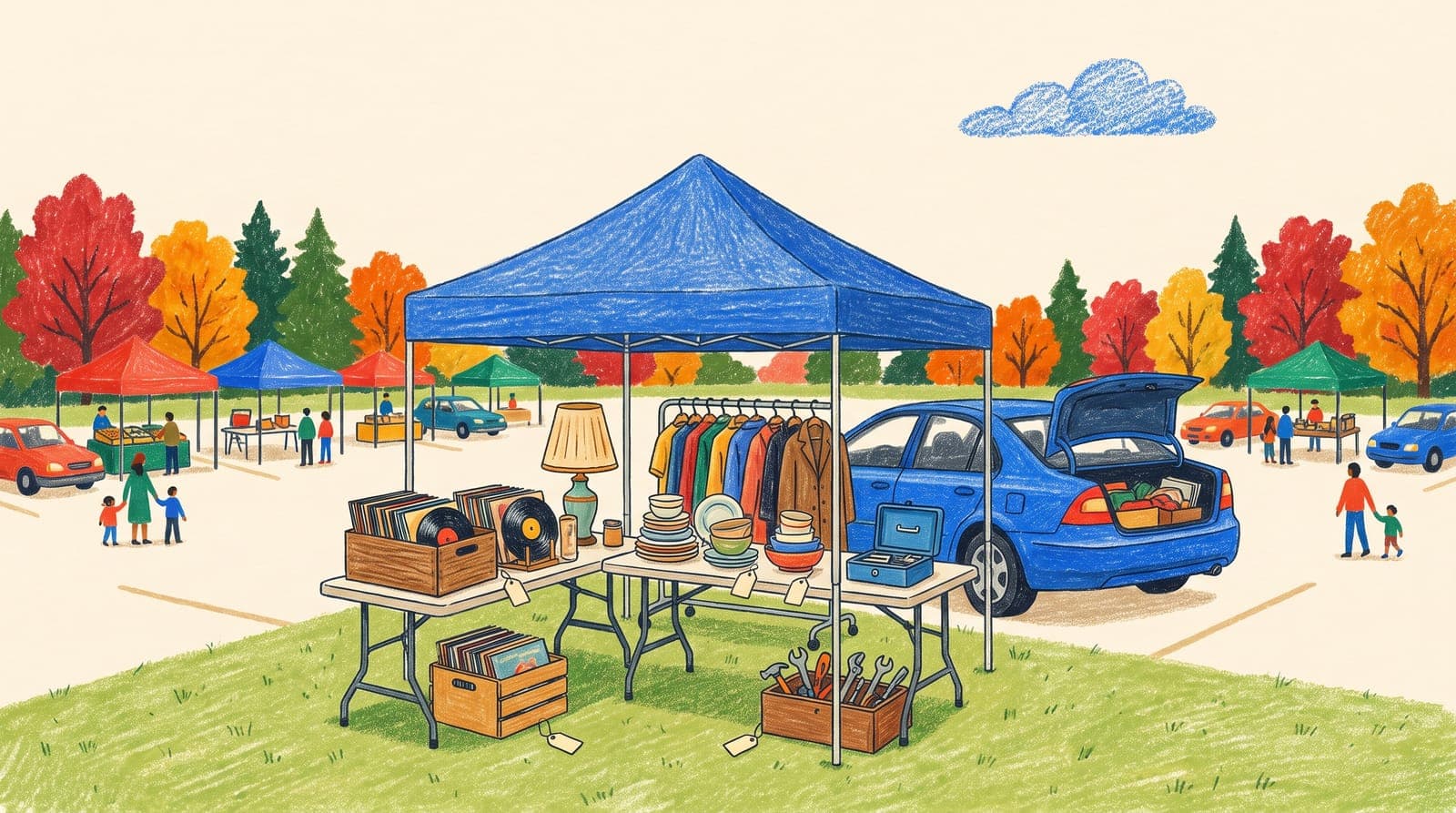
A flea market is the cheapest way to start selling in person. You rent a space for the day, back up the car, put out a table, and see what people pay. No jury, no waitlist, often no application. That's also why the questions pile up: how much the space costs, whether anything will sell, whether you need a permit to sell your own old stuff, and how to handle someone who offers you a dollar for a ten-dollar lamp.
This guide answers those with numbers. The booth fees come from the 601 flea markets and swap meets in the Vendorbound catalog, pulled on October 2, 2026. The tax rules come from the state agencies that write them. The earnings and the advice come from sellers who posted their own results on Reddit and in videos, each linked. If you make what you sell rather than resell it, read the section on crowds first: a flea market may not be the right room.
The short answer
- Cost. Of the 342 flea markets and swap meets in the catalog that publish a booth fee, half charge $25 or less for their cheapest space, and three quarters charge $50 or less. Some, like the San Jose Flea Market, let you drive in on the day without a reservation.
- Profit. Results run from a lost fee to several hundred dollars a day. One seller reported $500 to $700 profit on a Sunday after $18 in table rent; another made under $100 for two days.
- The crowd. Flea market shoppers come for deals. Tools, cheap toys and anything under eBay prices move; as one seller put it, "no one is going to the flea market for a $50 crochet cozy."
- Permits. If you sell regularly, California, Texas and Florida all expect a sales tax permit. California flea market operators can't rent you a space without seeing yours or a signed form saying you don't need one.
- The day. Arrive when the vendor gate opens, bring small bills and bags, price clearly or post a sign that you take offers, and stay until closing.
Is selling at a flea market profitable?
It can be, and it can also cost you a Saturday and the fee. The difference is mostly what you bring and which market you pick.
On r/Flipping, a seller who buys auction lots and clears the leftovers at a small-town flea market wrote: "I can usually pull in anywhere from 500-700 dollars Profit on those days. Thats after taking out the cost of my tables (18$) and the cost of the items." In the same thread, another commenter answered that a summer of trying "didn't make more than $100 for 2 days worth of work (not including prep and the ungodly heat)", selling housewares and old handbags.
First days on video show the same spread. One TikTok seller posted "My 1st Flea Market was a FLOP!! Paid $30 in a selling Fees Only made.... $12", because the school running the event hadn't advertised. A small studio posted its first flea market results as "Cost to sell: $250", "Total sales: $99", with the lesson "Know your audience - our booth wasn't the right fit for this market's demographic". A third, selling shirts and party supplies, ended the first day at "a total of $165".
And sometimes junk does better than expected. One person who took household leftovers to a swap meet instead of holding a garage sale wrote that the regulars bought it before the gates opened to the public: "I was expecting around $300 and left at the crack of dawn $900."
The way to judge it: subtract the space, gas and anything you bought to sell from what you took in, then divide by the hours, setup and teardown included. A flea market pays when you have cheap inventory and a lot of it, because the margin per item is small and the volume is the point.
How much does a flea market booth cost?
On October 2, 2026, the Vendorbound catalog listed 601 flea markets and swap meets (car-part swap meets left out). 342 of them publish a booth fee. Taking the cheapest space each one lists:
| Cheapest space | Share of the 342 |
|---|---|
| $15 or less | a quarter |
| $25 or less | half |
| $50 or less | three quarters |
| Over $100 | 22 markets |
Fourteen more list their spaces as free. What you get for the money varies, so read the fee page, not just the number. A few real examples, from each market's own page:
- San Jose Flea Market in California: daily open-air spaces are $35 or $40, corners $65 or $80, with a $10 fee per space per day to reserve a weekend spot in advance. One car per open-air space.
- De Anza College Flea Market in Cupertino, California, on the first Saturday of the month: a standard 14 by 14 foot booth is $50 and an XL booth $75.
- Golden Nugget Antique & Flea Market in Lambertville, New Jersey: you rent the market's tables, and its catalog page lists $30 for two outdoor tables on Wednesdays and Saturdays, $50 on Sundays, a little more under the pavilion.
- Renningers Flea Market in Mount Dora, Florida: spaces rent by the day, week or month, from $15 a day for a space with no tables to $390 a month for a secured space with tables and power.
At both San Jose and Golden Nugget, Sunday costs more than Saturday, and corners or covered spots cost more than plain open ones. A vintage seller who has done markets for years wrote that they have "paid as little as $10 and as much as $185 for a 10x10 space", and that a pricier market isn't a promise: "I've paid top dollar for a space and still only made a couple hundred bucks."
Also check what the market adds on top: electricity, a reservation fee, a late fee if you arrive after the cutoff, or a deposit for monthly spaces. The catalog's event pages list these where the market publishes them.
Flea market, swap meet, or craft fair: who are you selling to?
The words overlap. A swap meet is a flea market by another name, as Traders Village puts it, and in big cities some "flea markets" are really curated craft shows. What matters is who walks in and what they came for.
At a classic flea market, shoppers want a bargain and expect to negotiate. When a first-time vendor on r/CraftFairs posted that their Sunday at a New York flea market brought zero sales, the top reply was blunt: "Flea markets are usually not like craft shows or pop up markets. Just about anyone can sell there and most people go to flea markets looking for a deal." Another seller who does well at fleas put it more briefly: "no one is going to the flea market for a $50 crochet cozy."
Every market also has its own crowd. A long-time flea seller said: "There are 5 fleas near me and each has its own thing", and that they bring different stock to each. The cheapest research there is: walk the market as a shopper first. One vendor wrote they "attended our flea market at least a half dozen times before deciding to become a vendor there."
If you sell handmade goods at handmade prices, a craft fair or holiday market will usually suit you better. The farmers market guide covers the other kind of weekly market.
What sells at a flea market, and what not to sell
Sellers on Reddit keep naming the same things:
- Tools. "Tools always sell really well at my flea market," wrote the auction-lot seller above, rusted hammers included.
- Cheap toys. "Have a section of cheap, $1 toys," advised one reply in the most-read thread on the topic. "Kids will bug their parents to buy one and if it's just a dollar they will."
- A few bigger-ticket items. "Bring big stuff if you can that will bring $25 or more. It's hard to be profitable without larger-ticket items," wrote a regular seller.
- Things too bulky to ship. A monthly flea seller called it "good for unloading cheap things for the price you paid or items too bulky for shipping," since the buyer carries it home.
- Bins. A $1 box and a $5 box let people dig, which they like, and clear things not worth pricing one by one, as one seller suggested.
What not to sell starts with the market's rules. San Jose, for example, bans guns and ammunition, counterfeit items, alcohol, tobacco and prepared food. Some, like San Jose and De Anza, keep food for their own concessions, and others require a county health permit, so check before you bring snacks to sell.
Then there's federal law. The Consumer Product Safety Commission says its rules apply to anyone who sells consumer products, "including thrift stores, consignment stores, charities, and individuals holding yard sales and flea markets." Recalled products can't be resold, and the CPSC tells resellers not to sell "any broken or wobbly nursery furniture, or durable infant product that is missing parts, even if it has not been recalled." Before you put out cribs, car seats, strollers or children's toys, check them against the recall list in the CPSC's free Reseller's Guide on that page.
Do you need a seller's permit to sell at a flea market?
Usually yes, unless you only sell your own used things once or twice a year. The rule is set by your state's tax agency, and flea markets are one of the places states check.
California. The CDTFA says people who sell "new or used merchandise in California, including handcrafted items, are generally required to hold a seller's permit." Flea market and swap meet operators may not rent you a space until they have your permit number or a signed CDTFA-410-D saying you don't need one. The exception is the occasional seller: the CDTFA's own example is someone who sells at a swap meet "no more than two times each year." If you'll sell for a limited period, there's a temporary seller's permit. San Jose asks for your resale permit after your second space, and the Rose Bowl Flea Market asks occasional sellers for the CDTFA-410-D.
Texas. Sellers at markets and shows "are engaged in business in Texas and must have a Texas Sales and Use Tax Permit" if they sell taxable items, and the permit is free. The occasional sales exemption covers one or two sales a year, or up to $3,000 a year of things bought for your own household, but the Comptroller says it doesn't apply when you pay a fee to sell at a flea market or a similar event run by someone else.
Florida. A business that sells taxable goods must register to collect sales tax, and markets enforce it: Renningers requires a Florida sales tax certificate.
In the catalog, 82 of the 601 flea markets and swap meets name a sales tax permit or resale certificate in their vendor rules. Many more expect one without saying so. Some cities also want a business license; De Anza's vendor page notes it's separate from the seller's permit. Only 69 of the 601 list an insurance requirement (the Rose Bowl is one), but if a market asks for a certificate, the vendor insurance guide explains what it costs.
How to price and haggle at a flea market
Sellers split on whether to put prices on things, and both sides are loud about it.
The case for pricing: "Make sure everything is priced, and the labels are clearly visible. I hate when nothing is priced and the seller expects people to just ask. People will just walk away," wrote one buyer. Another said: "I bypass all vendors who don't price their items."
The case against: one seller learned that unpriced items on a small table "makes people engage about what they want and I can truly gauge their interest." It works best when you're good at talking to strangers and the market's regulars expect it.
For a first market, price things. A middle path many sellers use is a sign that invites offers. One uses: "Like the item but not the Price? Let's talk." Then:
- Price against the market, not eBay. "Don't mention ebay pricing. Make sure everything is under that," said a regular. Walk the aisles before you open and see what similar things are marked.
- Leave room to come down. Expect offers well under your price. A reply on r/CraftFairs warned: "Be emotionally prepared for them to offer 10% of your asking price."
- Take the reasonable offer. The vintage seller above puts it plainly: if someone "offers me $35 on a $40 blouse, I'm taking it."
- Peel off old stickers. Leftover retail tags invite "but this sticker says X price," as one seller noted.
- Bundle. Two for one price clears stock and makes the haggler feel they won.
The goal of the day is to go home with less than you brought. As one reply put it: "Object is to make money and not bring it all back home with you."
Cash, cards, and change
Flea markets still run on cash, so change is the first thing to pack. "Everyone has only 20s from the ATM and will inevitably buy a sole $1 item and need change," wrote one reply; San Jose's own tips say the same: its ATMs only dispense $20s. Bring plenty of ones and fives, and keep the money on you, not in a box on the table.
Take cards and phone payments too. The vintage seller above takes Venmo, PayPal, Cash App, Square and cash, and brings "about $50 in singles, fives, and tens" for change. A card reader costs a little per sale: Square's free plan charges 2.6% plus 15 cents for an in-person card payment, or 41 cents on a $10 sale. If a $1 item isn't worth that, post a card minimum.
What to bring and how to set up
Most flea markets give you a patch of ground and nothing else, so bring the booth with you. Check whether your market supplies tables: Golden Nugget rents them, while the Rose Bowl tells sellers to "supply your own tables and chairs."
- Tables, and a second level. "People pay more for stuff on a table that on the floor, and more for stuff that's displayed than in a heap," wrote one seller, who adds shelves on upturned bins for a second tier.
- Shade. A sun shade "keeps the merch in better shape, keeps you from fatiguing so quickly, and gets people to come in for the shade on hot days," wrote a seller of many years. A pop-up canopy needs weight on every leg; see how much canopy weight you need.
- Tarps and clips. A tarp for rain, and clothespins or clips so tablecloths and signs don't blow away.
- Bags. Grocery bags or paper bags for buyers who arrive empty-handed.
- A wagon. If you can't park at your space, a folding wagon saves a dozen trips. The vintage seller above bought one after hauling racks down a broken sidewalk.
- Water, sunscreen, a hat, and food. You'll be there from before dawn to mid-afternoon.
The vendor checklist has the full packing list for any market booth.
Your first flea market day
Flea markets start early. San Jose's vendor gates open at 5 a.m. on weekends, and sellers must be set up before 8 a.m. or the space is resold. De Anza's move-in runs 5:30 to 7:30 a.m., and its catalog page notes no vehicle can enter or leave from 7:30 a.m. to 2 p.m. Find out the cutoff and beat it.
Expect early buyers. Resellers and regulars walk the rows while you unpack, and some of your best sales happen before opening. A buyer on r/Flipping suggests rope or tape to keep people from wandering in while you set up. Have prices on things before you open the bins.
Stay late. One seller noticed the regulars "roll in late and leave early" and advised against copying them: late shoppers "came to spend money" and find fewer tables to spend it at.
Get to know your neighbors. Someone has to watch your table while you take a break, and the sellers around you know which markets are worth it. One reseller said of the other sellers: "I've gotten so much great inventory free that way."
Then write down the fee, the take and the hours before you forget them. After three markets you'll know which one to keep.
Where to find flea markets and swap meets now
Live from the Vendorbound catalog
778 flea and vintage markets are taking vendor applications now
1,465 in the catalog. Where there are the most:
- Flea markets in California82 open
- Flea markets in Ohio47 open
- Flea markets in Florida44 open
- Flea markets in North Carolina40 open
- Flea markets in Pennsylvania37 open
- Flea markets in Texas36 open
On October 2, 2026, the catalog listed 601 flea markets and swap meets, 334 of them taking vendors now, most in California (90), Ohio (39) and Texas (26); 413 run on Saturdays and 324 on Sundays.
Frequently asked questions
How much does it cost to sell at a flea market?
Not much, as markets go. Of the 342 flea markets and swap meets in the Vendorbound catalog that publish a booth fee, half charge $25 or less for their cheapest space and three quarters $50 or less. Weekend days, corner spaces and covered spots cost more.
Do you need a license to sell at a flea market?
If you sell regularly, California, Texas and Florida require a sales tax permit (Texas charges nothing for it); California and Texas exempt a seller who sells only once or twice a year. California operators must see your seller's permit or a signed CDTFA-410-D before renting you a space. Some cities also require a business license.
Is selling at a flea market worth it?
It is when you have cheap inventory in volume, such as auction lots, yard sale finds or a house to clear out. Sellers report anywhere from losing the fee to several hundred dollars a day. Handmade goods at craft prices usually do better at craft fairs.
What sells best at a flea market?
Tools, cheap toys, things too bulky to ship, and anything priced under what it costs online. Sellers advise mixing $1 bins with a few items that bring $25 or more, since small items alone rarely cover the day.
Should I put prices on everything at a flea market?
For a first market, yes. Many buyers skip tables with no prices. If you want to haggle, price items and add a sign that you take offers.
Do flea markets take credit cards?
The market doesn't; each seller decides. Most buyers bring cash, so carry small bills for change, but a card reader or a phone payment app wins sales from people who don't. Square's in-person rate on its free plan is 2.6% plus 15 cents.